“
The types of ballroom dances fall into four practical families: smooth dances that travel around the floor (Waltz, Foxtrot, Tango, Viennese Waltz), Latin and rhythm dances danced in place (Rumba, Cha Cha, Bolero, Samba, Mambo), social and club dances (Salsa, Bachata, Merengue, Hustle), and swing dances. Most beginners start with two or three and build from there.
That is the short answer. The longer answer is more useful, because knowing how these families relate to each other is what makes learning them feel simple instead of overwhelming.
Our studio in Clearwater teaches 15 verified styles spanning American and International dancing: Waltz, Foxtrot, Tango, Viennese Waltz, Cha Cha, Rumba, Salsa, Bachata, Mambo, Samba, Bolero, Merengue, Swing, Hustle and Argentine Tango. You do not need to learn all 15. You need to know which few belong to the life you actually live, and this guide will help you find them.
The Two Big Categories: Standard vs Latin Dance
Almost every partner dance sorts into one of two movement ideas. Understanding this single distinction does more for a beginner than memorising a long list of ballroom dances.
- Progressive dances travel. You and your partner move together around the perimeter of the floor in a counter-clockwise flow. Waltz and Foxtrot are the classic examples.
- Spot dances stay put. You work within a small area, with the movement expressed through the hips, the feet and the timing rather than covering ground. Rumba and Cha Cha live here.
The formal names for these groupings depend on which system you are studying. In American style ballroom, the progressive group is called Smooth and the spot group is called Rhythm. In International style ballroom, the same split is called Standard and Latin.
The vocabulary differs. The physical skill overlaps a great deal. A beginner who learns to lead and follow a box step in American Waltz has already built something that transfers straight into International Standard.
What Are the 5 Ballroom Dances?
When people ask what are the 5 ballroom dances, they are usually thinking of the five International Standard dances, which are the ones you see in competition and on television:
- Waltz — slow, rising and falling, in 3/4 time
- Tango — sharp, deliberate, staccato
- Viennese Waltz — a faster Waltz built on continuous turning
- Foxtrot — smooth, walking, unhurried
- Quickstep — light, bright and quick, with hops and runs
There is a matching set of five International Latin dances: Cha Cha, Samba, Rumba, Paso Doble and Jive.
Here is the honest note for a first-time student. Those ten dances describe a competition framework, not a Tampa Bay Saturday night. The dances you are most likely to need at a wedding reception in Dunedin, a Latin night in Ybor City or a cruise out of Port Tampa Bay are Foxtrot, Waltz, Rumba, Cha Cha, Swing, Salsa and Bachata.
Smooth Dances: The Traveling Group
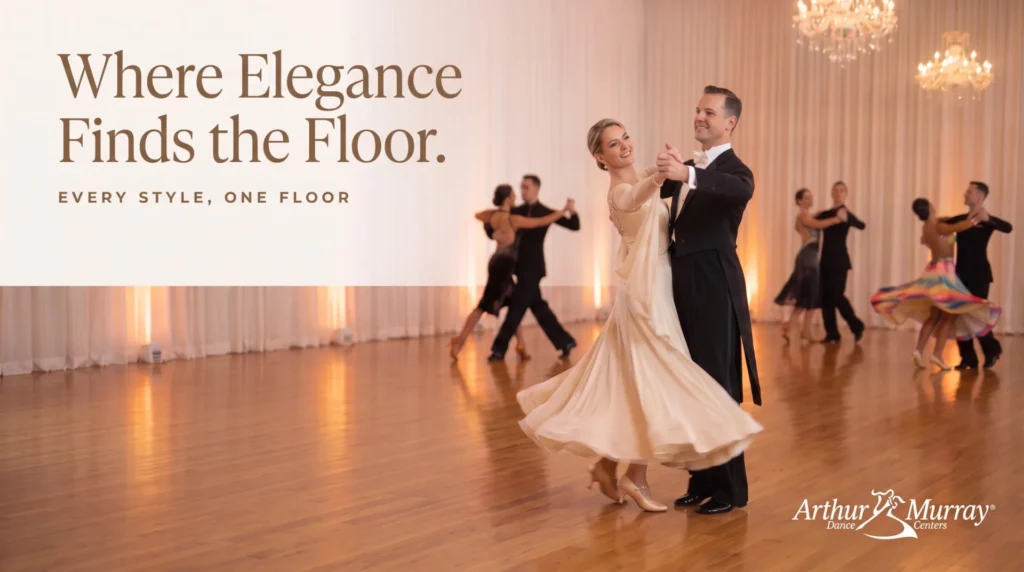
Smooth dances are the ones most people picture when they hear the word ballroom. You hold a frame with your partner, you move as one unit, and you cover the floor.
Waltz
Waltz counts in three instead of four, which gives it that gentle rise-and-fall feeling. It is slow enough to think in, which is exactly why it is often a first lesson. If you are planning a wedding first dance to a ballad, Waltz is frequently the answer.
Foxtrot
Foxtrot is walking, organised. It fits an enormous range of music — Sinatra, standards, most easy-listening radio and a surprising amount of modern pop. Of all the types of partner dances, Foxtrot is arguably the most useful per hour invested, because so much live music at Tampa Bay events happens to sit in its tempo.
Tango
Tango replaces the flow of Waltz and Foxtrot with pauses and clean, decisive movement. Students who feel self-conscious about looking soft often love Tango, because the character is grounded and confident rather than sweeping.
Viennese Waltz
Viennese Waltz is Waltz at roughly double the speed, built around continuous rotation. It looks advanced. It is actually built on a small number of repeating figures, which is why students reach it sooner than they expect.
Latin and Rhythm Dances: The Spot Group
Rhythm dances stay in one area and put the interest into timing, hip action and partnering. You need less floor space, which makes them practical for crowded rooms and for practising in your own kitchen.
Rumba
Rumba is the slow romantic one. It is the Latin dance most often taught first, because the tempo gives you time to feel what your feet and hips are doing.
Cha Cha
Cha Cha is playful, crisp and built around a small triple step that gives the dance its name. It fits a huge amount of pop and funk music, so it travels well from lesson to party.
Bolero
Bolero is sometimes called the most beautiful of the rhythm dances. It is slow like Rumba but adds the rise and fall of a smooth dance, so it sits between the two families.
Mambo and Samba
Mambo is bold, accented and full of energy. Samba carries a bouncing, rolling action that comes from Brazilian rhythms. Both reward a student who already has a little confidence and wants something with more drive.
Social and Club Dances: What You’ll Actually See Out
This group matters more in Pinellas County than the competition taxonomy suggests, because these are the social dance styles playing at real venues around the bay.
- Salsa — fast, turning, endlessly social; the backbone of Latin nights across Tampa and St. Petersburg
- Bachata — Dominican, close, with a distinctive hip motion on the fourth beat; currently the most requested dance among new students almost everywhere
- Merengue — the simplest partner dance to learn, a marching step you can use within one lesson
- Hustle — the disco-era spin dance, and the one that fits a startling amount of modern dance-pop
If your goal is to walk into a club and dance with anyone, this is your shortlist. Merengue and Bachata in particular give a total beginner something usable very quickly, which builds the confidence needed for everything else.
Swing and Argentine Tango: Two Worlds of Their Own
Swing is the American original, danced to big band, blues, rockabilly and plenty of contemporary music. It is bouncy, forgiving and genuinely fun on the first night. Swing also has cousins — West Coast Swing is smoother and more linear, Lindy Hop is the older, more athletic form.
Argentine Tango is a separate tradition from ballroom Tango, with its own posture, its own embrace and its own improvised approach. Dancers describe it as a conversation rather than a routine. It attracts adults who want depth in one dance rather than breadth across many.
Nightclub 2-Step deserves a mention too. It handles slow, modern love songs that do not fit Waltz or Rumba, which makes it quietly valuable for wedding couples.
Which Types of Ballroom Dances Should You Start With?
Start with the dances that match your reason for walking in the door. That is the whole method.
- Wedding first dance: Foxtrot, Waltz or Rumba, chosen by the song. Nightclub 2-Step if the song is slow and modern.
- Couples wanting time together: Rumba and Foxtrot. Slow tempos, immediate partnering skills, low frustration.
- Latin nights out: Bachata and Salsa, with Merengue as the confidence builder in week one.
- Active seniors: Foxtrot, Waltz and Swing. Manageable tempos, real social value, and dances you will hear at community events across Pinellas.
- Cruises and travel: Foxtrot, Cha Cha and Swing cover most of what any ship’s band will play.
You will notice Foxtrot appears on nearly every line. That is not an accident. It is the most transferable dance in the catalogue.
How the Dances Connect to Each Other
Here is the part that surprises new students most. The ballroom dance styles are not 15 separate subjects. They share a small set of underlying skills, and that is what makes learning them faster than it looks.
- Frame and connection transfer from every dance to every other dance
- Leading and following is one skill, practised in different rhythms
- Box steps appear in Waltz, Rumba and more
- Rock steps and triples connect Swing, Cha Cha and Mambo
- Timing awareness built in one dance makes the next one quicker to hear
This is the reason the Arthur Murray method teaches an interrelated system rather than isolated routines. Your second dance takes less time than your first. Your fifth takes less again. You can see the full range of styles we teach on our dance styles page.
Common Beginner Questions
Do I need a partner?
No. Plenty of adults start alone and learn with an instructor. Leading and following are both taught as skills, so single students end up perfectly capable on a social floor.
How many dances should I learn?
Two or three is a comfortable start. Five or six covers almost any social occasion in Tampa Bay. Beyond that, you are adding range for enjoyment rather than necessity.
Should I choose American or International style?
For social dancing, American style is the usual path, because Smooth and Rhythm are built around what happens at parties and receptions. International style suits students drawn toward competition and formal technique. Either way, the first few lessons look much the same.
What if I have no rhythm?
Rhythm is taught, not inherited. Counting music is a learnable skill, and slow dances like Rumba, Merengue and Foxtrot are deliberately chosen first so you have time to hear the beat before you have to move quickly.
Your Next Step
Pick one dance from the list above that matches your reason for wanting to dance. One is enough to begin. The rest of the map opens up on its own once you are standing on the floor with a frame and a count.
Adults across Clearwater, Dunedin, Palm Harbor, Largo and St. Petersburg walk into our studio on US Highway 19 with no experience at all. That is the normal starting point, not the exception. Don’t postpone your dream — the version of you who can dance at any wedding, cruise or Latin night starts with a single first step.
”