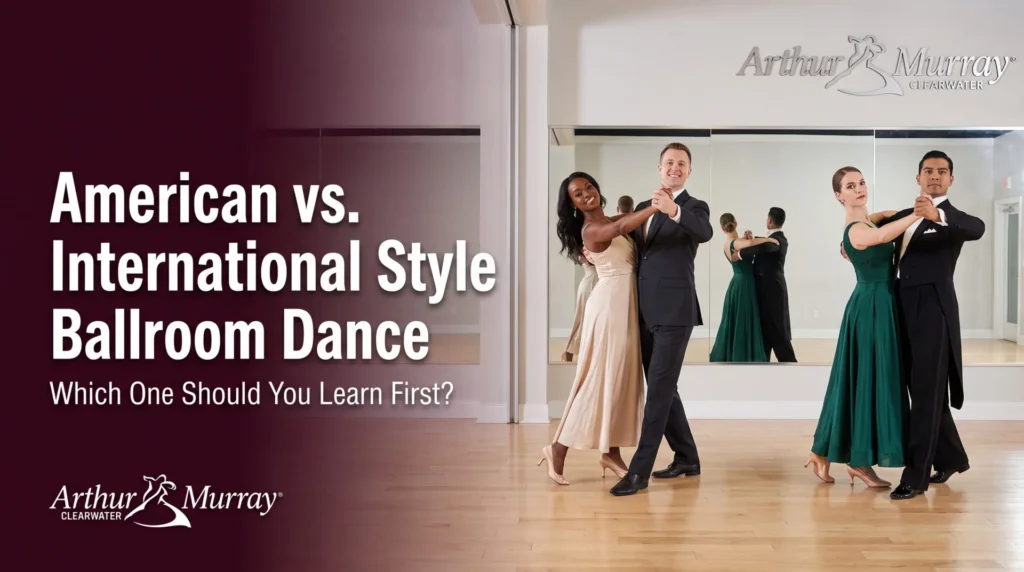
Anyone who spends more than a few weeks researching ballroom dance runs into this distinction eventually, usually with some confusion. There are two major systems of ballroom dance in the world — American style and International style — and they divide the same underlying dances into different categories, with different technical requirements and different philosophies about what dancing is for.
For a beginner trying to decide where to start, this can feel like a barrier before you’ve even taken a lesson. It isn’t. The distinction matters less at the beginning than it does later, and understanding it clearly takes about five minutes. Here’s what actually separates the two, and what it means for someone learning to dance in Clearwater.
The Basic Divide
Both systems teach the same core dances — waltz, foxtrot, tango, cha cha, rumba, swing, and their relatives. What differs is how those dances are categorized, how strictly the technique is defined, and what the dancing is ultimately designed to accomplish.
International style is the global competitive standard. It’s organized into two divisions: International Standard, which covers waltz, tango, Viennese waltz, foxtrot, and quickstep; and International Latin, which covers cha cha, samba, rumba, paso doble, and jive. The defining technical characteristic of International Standard is that partners remain in a closed hold throughout the entire dance — bodies in contact, frame maintained, no separation. The syllabus is tightly defined, the technique is codified with considerable precision, and the whole system is built around competition. Judges evaluate against a specific, internationally recognized standard, which means consistency and technical accuracy carry enormous weight.
American style developed in the United States between roughly 1910 and 1930, shaped by American jazz music, a more social approach to dancing, and the influence of figures like Fred Astaire and Arthur Murray himself. It’s also organized into two divisions: American Smooth, covering waltz, tango, foxtrot, and Viennese waltz; and American Rhythm, covering cha cha, rumba, swing, bolero, and mambo. The critical difference from International is that American Smooth permits open position — partners can separate, dance apart, execute underarm turns, and then come back together. That single allowance opens up enormous choreographic freedom, and it’s the most visible distinction between the two systems.
American style has also expanded over the decades to absorb dances that International doesn’t include — salsa, mambo, bolero, and West Coast Swing among them — because the system is more responsive to how people actually dance socially rather than being bound to a fixed competitive syllabus.
Why the Open Position Difference Matters More Than It Sounds
At first glance, “partners can separate” seems like a minor technical footnote. In practice, it changes the character of the dancing substantially.
When partners stay in closed hold for an entire dance, as International Standard requires, the technique becomes about the quality of that connection — the frame, the shared movement, the precision of two bodies moving as one unit. It’s demanding in a specific way, and at high levels it’s genuinely beautiful. But it also constrains what’s possible choreographically. There are only so many figures available when you never break contact.
American Smooth’s open position allows underarm turns, side-by-side sequences, dramatic separations and reunions, and choreography that reads more theatrically. It’s the style you’re more likely to see in films and on television, precisely because it’s more visually varied. For social dancers, it’s also more practical: real social dancing frequently involves opening up, spinning a partner, and coming back together. American style teaches that as a core part of the vocabulary rather than as an exception to it.
There’s a corresponding difference in how the two systems approach beginners. International style tends to be more disciplined from the outset — the technical requirements are more exacting earlier in the process. American style typically begins as a social hobby and progresses toward sport for students who choose that path. Neither approach is superior; they’re calibrated for different starting intentions.
What Arthur Murray Clearwater Teaches, and Why
Arthur Murray Clearwater teaches both American and International styles, with competitive training available in both. That’s worth stating clearly, because the studio isn’t limited to one system — students who want to pursue International Standard or International Latin at a competitive level can do so with instructors who compete at a high level themselves.
That said, the Arthur Murray method has its roots in American style, and there’s a coherent reason for that. Arthur Murray built a teaching system designed to take people who had never danced and make them capable, confident social dancers — quickly enough to keep them engaged, and thoroughly enough that the skill actually held up in the real world. American style, with its social orientation and choreographic flexibility, is the natural vehicle for that goal. It gets students dancing socially faster, and it covers a broader range of dances that people actually encounter at weddings, on cruises, and at social events.
For most new students at Arthur Murray Clearwater, the practical answer is that the American/International question resolves itself without much deliberation. You start learning, you develop foundations that transfer across both systems, and if competitive ambitions emerge later, the conversation about which competitive track to pursue happens then — with an instructor who knows your dancing and can advise accordingly. The foundational technique you build in your first months is not style-specific in any way that would lock you into a path prematurely.
Which Should a Beginner Actually Choose?
If you’re learning to dance for social reasons — weddings, cruises, date nights, social events, general confidence on a dance floor — American style is almost certainly the better starting point. The open position vocabulary matches how social dancing actually works. The broader range of dances covers more of what you’ll encounter. And the progression from social competence toward higher skill is gentler, which sustains motivation through the early stages where most people give up.
If you know from the outset that competition is your objective, particularly at the international level, then International style deserves serious consideration from the beginning. The technical discipline is more demanding early, but starting there avoids any later transition costs.
For the substantial majority of beginners, though, this question is less consequential than it appears. The fundamentals — posture, frame, weight transfer, timing, lead and follow — are shared across both systems. A student who builds those correctly has built them for both. The stylistic divergence becomes meaningful at intermediate and advanced levels, by which point you’ll have enough experience to make the choice with real information rather than guessing from the outside.
The more useful question for someone deciding whether to start dancing in Clearwater isn’t which style but whether the instruction is good. A well-taught American style foundation will serve you better than a poorly-taught International one, and vice versa. Technique quality, instructor skill, and structured progression matter more than the system label at the point where you’re starting from zero.
People Also Ask: American vs. International Ballroom Dance
What is the difference between American and International ballroom dance?
International style is the global competitive standard, divided into International Standard and International Latin, with partners remaining in closed hold throughout Standard dances. American style, developed in the United States, is divided into American Smooth and American Rhythm, and permits open position where partners can separate and reunite. American style also includes dances International doesn’t, such as bolero, mambo, and West Coast Swing.
Which ballroom style is better for beginners?
American style is generally considered more accessible for beginners learning to dance socially, because its open position vocabulary matches how social dancing actually works and its progression is more gradual. International style is typically more technically demanding early on, making it better suited to students with competitive ambitions from the outset.
What style does Arthur Murray teach?
Arthur Murray Clearwater teaches both American and International styles, including competitive training in both. The Arthur Murray method has roots in American style, which reflects the system’s original purpose of producing confident social dancers, but students pursuing International competition are fully supported.
What dances are in American Smooth and American Rhythm?
American Smooth includes waltz, tango, foxtrot, and Viennese waltz. American Rhythm includes cha cha, rumba, swing, bolero, and mambo. Both divisions permit open position, distinguishing them from International Standard.
Can you switch from American style to International style later?
Yes. The foundational technique — posture, frame, weight transfer, timing, and lead-and-follow — transfers substantially between systems. Students who build strong fundamentals in one style can transition to the other, though advanced technique diverges enough that the switch requires focused work at higher levels.
Is one style more difficult than the other?
Neither is objectively harder overall. International style is more technically demanding earlier in the learning process, with stricter requirements and less choreographic latitude. American style has a gentler entry but its own advanced complexities, particularly in open-position choreography. Both reach comparable difficulty at elite levels.
Start With Good Instruction, Not With the Right Label
The American versus International question is genuinely interesting, and it becomes more relevant as your dancing develops. But it is not the question that determines whether you’ll succeed as a beginner. That comes down to whether you’re learning from instructors who can teach — who watch what you’re doing, correct it precisely, and build your technique in an order that makes sense.
Arthur Murray Clearwater offers a free introductory lesson for new students, taught by instructors trained in both systems. It’s the most direct way to find out what good instruction feels like, and to have a real conversation about which path fits your goals.
Reach out to Arthur Murray Clearwater to ask about the current intro offer.