The Short Version
- Core Difference: East Coast Swing is circular, bouncy and set to faster music, while West Coast Swing travels back and forth along a narrow lane called a slot and works best with slower, smoother songs.
- Easier Starting Point: East Coast Swing is the easier of the two for a total beginner, because its triple step pattern repeats predictably and the lead and follow roles stay close together.
- Music Match: Choose East Coast Swing for big band, rockabilly and classic rock and roll. Choose West Coast Swing for blues, pop, R and B and anything with a relaxed groove.
- Local Reality: At Arthur Murray Clearwater we teach Swing and Hustle, and beginner swing lessons in Clearwater usually start with East Coast Swing so you have something you can use at a party within your first few weeks.
- Not a Permanent Choice: The two styles share a rhythmic family, so learning one shortens the road to the other rather than locking you out of it.
Picture a Saturday night on a Pinellas County dance floor. The band shifts from a fast, brassy number into something slow and bluesy, and half the couples on the floor change what they are doing entirely. The bouncing, spinning couples settle down, stretch out, and start moving along a straight line instead of around a circle.
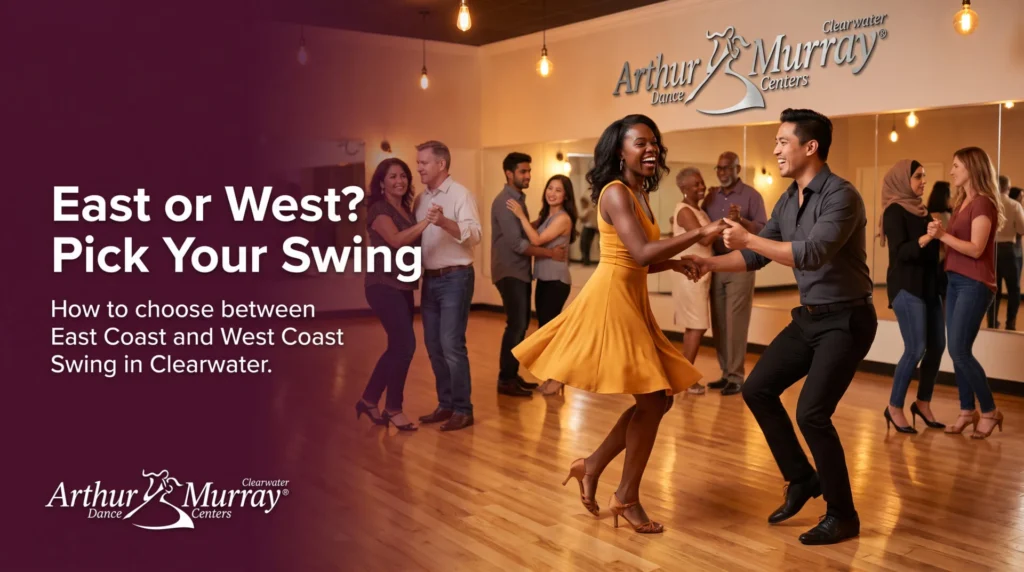
That change is the difference between East Coast Swing and West Coast Swing, and it is the single most common question adults ask us when they start looking at swing dance styles. Both are called swing. Both come from the same American roots. They feel almost nothing alike on the floor.
This article answers which one you should learn first, what each actually looks and feels like, and how to tell from the music which one a song is asking for. If you have never danced a step in your life, start here before you start anywhere else.
What Is the Difference Between East Coast and West Coast Swing?
Section Overview:
East Coast Swing is a circular, bouncy partner dance built on triple steps and a rock step, danced to fast music like big band and rock and roll. West Coast Swing is a smoother dance that travels along a narrow rectangular slot, uses elastic connection between partners, and suits slower blues, pop and R and B. Both are social swing dances taught at Arthur Murray Clearwater.
The clearest way to separate them is to watch the shape a couple makes on the floor. East Coast Swing partners rotate around a shared center, like two people turning a small wheel. West Coast Swing partners work along a line, with the follow traveling up and down that line while the lead steps out of the way and back in.
The second difference is the feeling in your arms. East Coast Swing has a springy, bounce-and-return quality that matches the beat of fast music. West Coast Swing uses a stretch-and-release connection, so the movement looks poured rather than popped.
The Differences That Actually Matter to a Beginner
- Floor Shape: East Coast Swing turns in a compact circle, which makes it forgiving on a crowded floor. West Coast Swing stays inside a slot, which makes it look organized and lets a whole room of couples run parallel lanes.
- Tempo Range: East Coast Swing lives at faster tempos and rewards energy. West Coast Swing lives at slower tempos and rewards patience.
- Connection Style: East Coast Swing uses a bouncier, more compressed connection between partners. West Coast Swing uses a longer, more elastic connection that stretches and recovers.
- Room for Interpretation: East Coast Swing patterns tend to run in recognizable shapes. West Coast Swing leaves more open space inside each pattern for the follow to play with timing and styling.
- Learning Curve: East Coast Swing gives you a usable social dance quickly. West Coast Swing takes longer before it feels like dancing rather than walking.
Neither is more advanced as a style. They ask different things of you, and one of those asks is simply easier to satisfy in your first month. You can see how Swing fits into our teaching approach alongside the other social dances we cover.
Which Swing Dance Is Easier for Beginners?
Section Overview:
East Coast Swing is easier for beginners. Its triple step timing repeats on a short, predictable cycle, partners stay in a stable frame, and the circular pattern forgives small mistakes. West Coast Swing requires a subtler elastic connection and more precise floor position, which most adults find easier to learn after they already have basic swing timing in their body.
The reason East Coast Swing comes first is repetition. The basic pattern recycles quickly, so within one lesson you have already danced the same rhythm many times. Repetition is what turns counting in your head into moving without thinking.
West Coast Swing asks you to manage distance, timing and a stretchy connection at the same time, while staying inside an invisible lane. That is a lot to coordinate before your body knows what swing rhythm feels like.
How the Learning Sequence Usually Unfolds
- First Sessions, Rhythm: You learn the rock step and the triple step swing timing without worrying about turns. The goal is hearing where the beat lands and stepping on it.
- Next, Frame and Lead: You add a consistent arm and body frame so the pattern can be led and followed rather than memorized separately by each partner.
- Then, Turns and Changes: Underarm turns and position changes get added onto rhythm you already own, which is why they feel like additions instead of new dances.
- After That, Music Variety: You practice the same material across different tempos and songs until the dance stops depending on one familiar track.
- Finally, the Slot: Once swing rhythm is automatic, West Coast Swing becomes a matter of learning the slot, the anchor and the elastic connection rather than learning swing itself.
This sequence is the practical reason our beginner path in Clearwater typically opens with beginner swing lessons for adults with no experience. You get something you can actually use socially before you take on the subtler style.
How Do You Tell Which Swing a Song Calls For?
Section Overview:
Tempo and feel decide it. Fast, driving music with a strong backbeat, such as big band, rockabilly and early rock and roll, calls for East Coast Swing. Slower, smoother music with a laid-back groove, including blues, soul, pop and R and B, calls for West Coast Swing. When a song sits between the two, either can work, and many social dancers choose by mood.
Start by counting the beat out loud with the music. If counting feels rushed and energetic, you are in East Coast Swing territory. If counting feels unhurried and you have time between beats, the song is asking for West Coast Swing.
The second test is the space around you. A packed floor at a Tampa Bay social favors the compact circle of East Coast Swing. A floor with room to stretch out favors the slot.
Reading the Room at a Social
Watch what the experienced dancers do when the song changes. Their choice is usually correct and takes two seconds to observe. Nobody at a social is grading you for guessing wrong, and switching mid-song is completely normal.
Live music in Pinellas County covers a wide range, from beachside cover bands to blues nights to wedding receptions. That variety is exactly why knowing both styles eventually pays off, and why our weekly practice parties in Clearwater play a mixed playlist rather than one narrow style.
Where Does Swing Fit Alongside the Other Dances You Might Learn?
Section Overview:
Swing belongs to the social and party group of partner dances, next to Hustle, Nightclub 2-Step and West Coast Swing. It pairs naturally with Latin rhythm dances such as Cha Cha and Rumba, which share a similar sense of beat, and with smooth dances such as Foxtrot that cover the slower, elegant end of a wedding or party playlist.
Most adults who come to us are not trying to become swing specialists. They want a handful of dances that cover a normal Tampa Bay social calendar, from a wedding reception to a night out with live music.
Swing sits at the center of that handful because so much American popular music fits it. Adding one smooth dance and one Latin dance around it covers most of what a DJ will play.
Natural Companions to Swing
- Hustle: Shares a partner-turning feel with swing but matches disco and modern four-on-the-floor pop, so it fills a gap swing cannot.
- Cha Cha: Reinforces the same skill of hearing a triple rhythm inside a beat, which makes swing timing more secure. Explore Cha Cha at our Clearwater studio.
- Foxtrot: Covers the slow, smooth, traveling songs at weddings and formal events where swing would feel out of place. See how Foxtrot works.
- Rumba: Handles slow romantic music and builds the connection and lead skills that West Coast Swing later depends on.
- Nightclub 2-Step: Fits slow ballads that are too slow for swing and too modern for Waltz, rounding out a social repertoire.
If you want a broader map before deciding, our guide to the types of ballroom and social dances lays out the full range in plain language.
What Should You Expect from Your First Swing Lesson?
Section Overview:
Expect a short conversation about your goals, then movement on the floor in the first session. At Arthur Murray Clearwater, an introductory lesson covers basic swing timing, a simple frame and one or two patterns, taught one step at a time. No partner, no experience and no dance clothing are required, and instructors adjust pace to the individual student.
The most common worry we hear is not about steps. It is about looking foolish in front of strangers. The structure of the Arthur Murray method exists specifically to remove that risk.
Material is introduced in small pieces, in a fixed order, so you are never asked to do something you have not been shown. That is what makes the method work for adults who are convinced they have no rhythm.
The Order a Beginner Actually Learns Things
- Goal Conversation: An instructor asks what you want dancing to do for you, whether that is a wedding first dance, a shared hobby, or confidence at social events.
- Rhythm Before Patterns: You find the beat and practice the East Coast Swing basics of rock step and triple step before any turns are added.
- Frame Before Speed: You build a comfortable, low-pressure connection with your partner at a slow tempo, then the tempo rises.
- Private Work, Then Group Practice: Individual instruction builds the material, and group classes let you use it with different partners at your own comfort level.
- Social Floor Last: Practice parties give you a low-stakes room to use what you learned, which is where the dance finally stops feeling like homework.
You can read more about how that progression is structured on our teaching process page, or look at the programs we offer for adults across Pinellas County.
Key Takeaways
- Shape Tells the Story: East Coast Swing turns in a circle, West Coast Swing travels along a slot, and that single difference drives almost everything else about how the two feel.
- Start With East Coast: Its repeating triple step timing and stable frame make it the faster path from no experience to dancing socially.
- Let the Music Choose: Fast big band and rock and roll call for East Coast Swing, while slower blues, pop and R and B call for West Coast Swing.
- Swing Anchors a Social Repertoire: Paired with Hustle, Cha Cha, Rumba, Foxtrot or Nightclub 2-Step, swing covers most of what you will hear at a Tampa Bay wedding or social.
- The Choice Is Not Permanent: Both styles share a rhythmic family, so time spent in one shortens the learning curve of the other.
Start Swing Dance Lessons in Clearwater and Greater Tampa Bay
Arthur Murray Clearwater teaches Swing and Hustle to adults with no experience, and we will point you to the right entry style based on the music you like and the events you want to dance at. Our studio at 25032 US Highway 19 N serves Pinellas County, with an affiliated Tampa and Hyde Park studio for students on the other side of the bay.
You do not need a partner, a background in dance or anything more than comfortable shoes. Reach out through our Clearwater contact page or call (727) 485-9169 to talk through where to begin.