Your Realistic Timeline for Learning to Dance
-
First Lesson: You dance on day one. Arthur Murray states that even a complete beginner will be dancing during the very first lesson, with no partner and no experience required.
-
Six to Twelve Weeks: Most adults reach comfortable social dancing in this window — a basic Rumba, a Foxtrot, a Swing, and the confidence to accept an invitation at a wedding or a practice party.
-
One to Two Years: Broad competence across several dances, with lead-and-follow skill that lets you dance with someone you have never met, to music you have never heard.
-
What Moves the Clock: Lesson frequency, practice between lessons, and how many dances you want. Arthur Murray’s own answer is that learning a few basics takes only a handful of lessons.
-
Wedding Deadline: Couples with a fixed date work backward from it. A first dance is a defined, finishable project, not an open-ended hobby.
A woman walks into our Clearwater studio on US Highway 19 North on a Tuesday afternoon in January. She is here because her daughter’s wedding is in May, she has never danced a step, and she has already decided she will be the one standing near the bar rather than on the floor. Her first question, before she has taken her coat off, is the same question almost everyone asks: how long is this going to take?
It is a fair question and it deserves a straight answer rather than a sales answer. How long it takes to learn to dance depends on what “learning to dance” means to you — one song at a wedding is a different project than being able to walk into any social floor in Pinellas County and dance all evening. This article gives you honest timelines for both, and explains what actually controls the pace.
The short version: you will dance on your first lesson, you will feel socially comfortable in a couple of months, and you will keep getting better for years if you want to. Everything below is the detail behind those three statements.
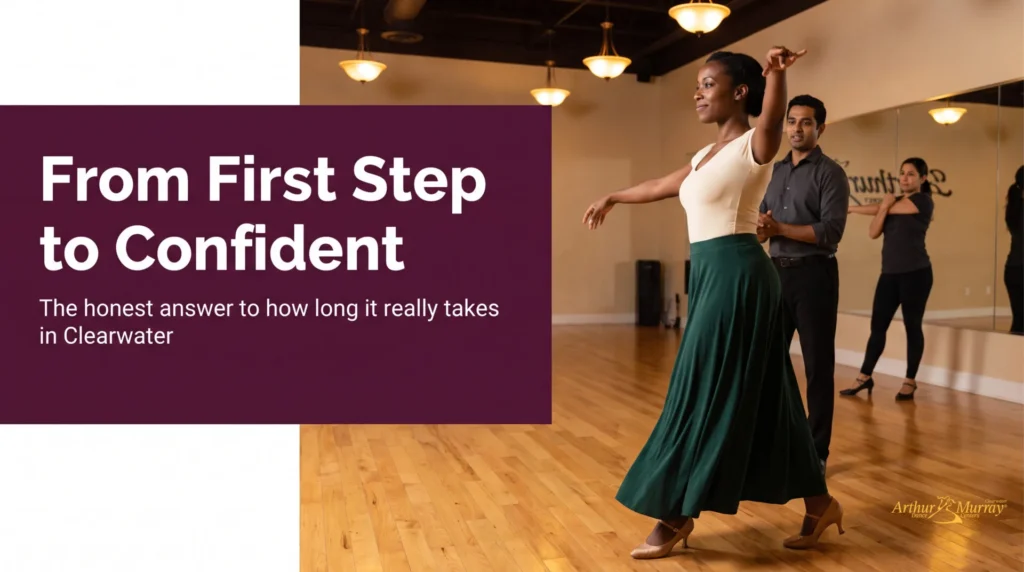
How Long Does It Take to Learn to Dance?
The Short Answer:
Learning to dance is a staged process, not a single finish line. A total beginner dances basic steps on the first lesson. Comfortable social dancing in two or three dances typically arrives within six to twelve weeks of steady lessons. Broad competence across smooth and Latin styles, including confident leading and following with strangers, generally develops over one to two years of consistent practice.
Why There Is No Single Number
Arthur Murray International’s own guidance on this question is refreshingly plain: the answer depends on how quickly you learn, what skill level you are aiming for, and how many dances you want. That is not evasion. A person who wants to survive one Waltz at a reception and a person who wants to social dance every weekend are doing two different amounts of work.
What stays constant is the starting point. Arthur Murray International states that no prior dance experience is required, and that the method was built to teach everyday people rather than naturally gifted movers. You are not behind. There is no group you missed.
The Learning Arc, Stage by Stage
-
Lesson One — Movement: You learn a basic step in one dance and move to music with a partner. Arthur Murray’s franchise guidance is explicit that even a complete beginner dances during this lesson.
-
Weeks One to Four — Vocabulary: You collect a handful of patterns in one or two dances and start recognizing which songs those dances fit. Counting still takes conscious effort.
-
Weeks Six to Twelve — Social Comfort: Basics become automatic enough that you can hold a conversation while dancing. This is the point most adults describe as “I can actually do this.”
-
Months Four to Twelve — Range: You add dances. Rumba, Cha Cha, Foxtrot, Swing and Waltz start reinforcing one another rather than competing for space in your head.
-
Year One to Two — Independence: You can dance with a partner you have never met, to a song you have never heard, and adjust in real time. This is the skill that makes a dancer, not a memorizer.
Why Dances Teach Each Other
The pace accelerates because the dances are related, not separate. Arthur Murray’s teaching material notes that every dance is broken into steps a beginner can learn and that concepts learned in one dance transfer to the others. Timing, frame, weight change and lead-and-follow are shared machinery.
In practice this means your third dance takes less time than your first. A student who has spent six weeks on Rumba lessons in Clearwater already understands Cuban motion and slow-quick-quick timing, so Cha Cha arrives faster. That compounding is the single biggest reason people underestimate how far they will get in a year.
What Actually Controls Your Pace
-
Lesson Frequency: Two touchpoints a week beats one. Motor learning fades between long gaps, so a weekly private lesson plus a group class or practice party progresses noticeably faster than a lesson every other week.
-
Practice Between Lessons: Five minutes in the kitchen counts. Reviewing a basic step three times a week between lessons is worth more than one long practice session the night before.
-
Number of Dances: Depth versus breadth is a real tradeoff. Two dances learned well produce social confidence sooner than six dances learned shallowly.
-
Floor Time With Strangers: Dancing only with your instructor builds one habit. Dancing at a practice party with a rotation of partners builds the adaptable version of the skill.
-
A Deadline: A wedding date, a cruise out of Port Tampa Bay, or a milestone anniversary concentrates practice in a way an open-ended goal does not.
When These Timelines Do Not Apply
They do not apply if you are training for competition. Competitive standards under bodies such as the National Dance Council of America involve a different volume of coaching and a much longer arc, and nothing in this article is a timeline for a medal.
They also shift if you have a mobility limitation, a recent injury, or a balance concern. That is not a barrier to dancing, but it changes sequencing — an instructor will build your program around what your body does comfortably today, which is one reason the Arthur Murray teaching process starts with a conversation rather than a curriculum.
Planning Your Timeline: Weddings, Snowbird Seasons and Social Floors
The Short Answer:
Work backward from your goal. Wedding couples usually need six to twelve weeks of steady lessons to perform one choreographed dance comfortably. Winter residents in Pinellas County can build genuine social skill inside a single season by concentrating lessons from January through March. Year-round social dancers should plan in months, not weeks, and expect Rumba, Foxtrot and Swing to carry most floors.
The Wedding First Dance Timeline
A first dance is the most predictable project in dance, because it has a fixed date, a fixed song and a fixed length. Most couples who start six to twelve weeks out arrive at their reception with a dance they can perform without counting out loud. Couples who start three or four weeks out can still get a clean, simple, genuinely nice dance — it is just a smaller dance.
The variable people underestimate is the shoes and the dress. Practicing in sneakers and then performing in a gown and unfamiliar heels changes balance in a way that surprises brides on the night. Bring the actual shoes to lessons in the final two weeks. Our wedding dance preparation program is built around that kind of practical detail.
Timeline Comparison by Goal
-
One Song at a Reception: Six to twelve weeks of steady lessons. Narrow, choreographed, deadline-driven. Fastest visible result of any goal on this list.
-
Comfortable at a Party: Two to three months. Two or three dances, danced socially rather than choreographed, enough to accept an invitation without hesitating.
-
Confident Social Dancer: Six to twelve months. Five or more dances, reliable lead and follow, able to handle a mixed playlist from Waltz to Salsa.
-
Broad Competence: One to two years. Smooth and Latin both developed, styling emerging, comfortable dancing with any partner in the room.
-
Ongoing Craft: Indefinite, by choice. Dancers who have been at it for a decade are still refining. That is the appeal, not a failure of the timeline.
The Snowbird Season Problem
Winter residents who arrive in Pinellas County in December and leave in April face a specific version of this question. Four months is enough time to get genuinely good — but only if the lessons start in the first two weeks rather than in February.
The practical approach is to concentrate: more frequent lessons during the season, then a maintenance plan for the months up north. Because Arthur Murray operates studios across the country, the vocabulary and the method travel with you. The Clearwater studio also coordinates with the affiliated Tampa and Hyde Park studio for students who split time across the bay.
Which Dances Get You Dancing Fastest
If speed to social confidence is your priority, the dance order matters. Rumba, Foxtrot and Swing cover the largest share of music you will actually hear at a Clearwater wedding, a Dunedin restaurant with a band, or a party on Sand Key.
Rumba teaches Latin timing and connection. Foxtrot instruction handles most standards and big-band material. Swing dance classes cover rock and roll, blues and much of what a cover band plays. Add Salsa lessons or Bachata once those three are steady and you have covered most rooms in Tampa Bay.
What Progress Actually Feels Like Month by Month
-
Month One — Conscious Effort: You count, you watch your feet, and you think about every step. This is normal and it does not last.
-
Month Two — First Automatic Moment: A basic step happens without you deciding it. Usually noticed on a practice party floor rather than in a lesson.
-
Month Three — Music Recognition: A song comes on the radio and you identify it as a Cha Cha before you think about it. This is a genuine milestone.
-
Month Six — Partner Independence: You dance with someone new and it still works. Lead and follow have become a skill rather than a memorized agreement.
-
Month Twelve — Style Emerges: You start making choices about how you move, not just what you move. This is where dancing stops being homework.
The Practical Details That Slow People Down
Two logistical things cost beginners more time than anything technical. The first is shoes. Arthur Murray studios recommend smooth soles rather than fashion or wedding shoes for early lessons, because suede or leather soles give the balance of slip and traction you need to turn under control without marring the floor.
Arthur Murray guidance for beginners suggests a closed toe to protect against a partner’s early footwork, avoiding slip-ons and sling-backs since you will be moving backward, and starting with flats or a modest heel — a half-inch heel is sufficient for all types of ballroom dancing unless you are competing. The second time-waster is skipping practice parties. Clearwater practice parties are where lesson material becomes real dancing, and students who attend regularly progress visibly faster than those who do not.
What About Clothing and Equipment
Almost nothing is required. Arthur Murray International’s official guidance is that no special clothes are needed — students come straight from work, school or the gym — and the only footwear requirement is shoes that will not slip off your feet.
You also do not need a partner. Arthur Murray franchise guidance confirms that students enroll as singles, as couples, or with a partner who has no interest in dancing at all. That last case is more common in Pinellas County than people expect, and it works fine.
Key Takeaways
-
Day One Counts: You dance during your first lesson, with no experience and no partner required. The timeline starts at zero, not after some preparatory period.
-
Six to Twelve Weeks for Social Comfort: Steady lessons over this window produce two or three usable dances and the confidence to accept an invitation.
-
One to Two Years for Range: Broad competence across smooth and Latin dancing, including dancing with unfamiliar partners, develops over this longer arc.
-
Transfer Speeds You Up: Concepts learned in one dance carry into the next, so your third dance takes far less time than your first.
-
Frequency Beats Intensity: Two shorter touchpoints a week, including a practice party, outperform one long session every other week for every goal on this list.
Start Your Dance Timeline in Clearwater
The honest answer to how long it takes is that the hardest part is the first fifteen minutes, and that part is over before you have taken your coat off. Everything after that is a matter of how often you show up. Arthur Murray states that 40 million people have learned to dance through its studios since the method began in 1912, which is a long record of teaching adults who were certain they could not.
The studio at 25032 US Highway 19 N in Clearwater serves students across Pinellas County and greater Tampa Bay, with an affiliated location in Tampa and Hyde Park. Call (727) 485-9169 or use our Clearwater studio contact page to talk through your goal and your date. If you are still deciding which style to start with, the guide to ballroom and Latin dance styles is a good place to begin.
External References
-
Arthur Murray International: The official Arthur Murray organization site, covering the teaching method and studio network.
-
National Dance Council of America: The NDCA governing body for ballroom dance standards and competitive rules in the United States.
-
USA Dance: The USA Dance national organization for amateur social and competitive ballroom dancing.