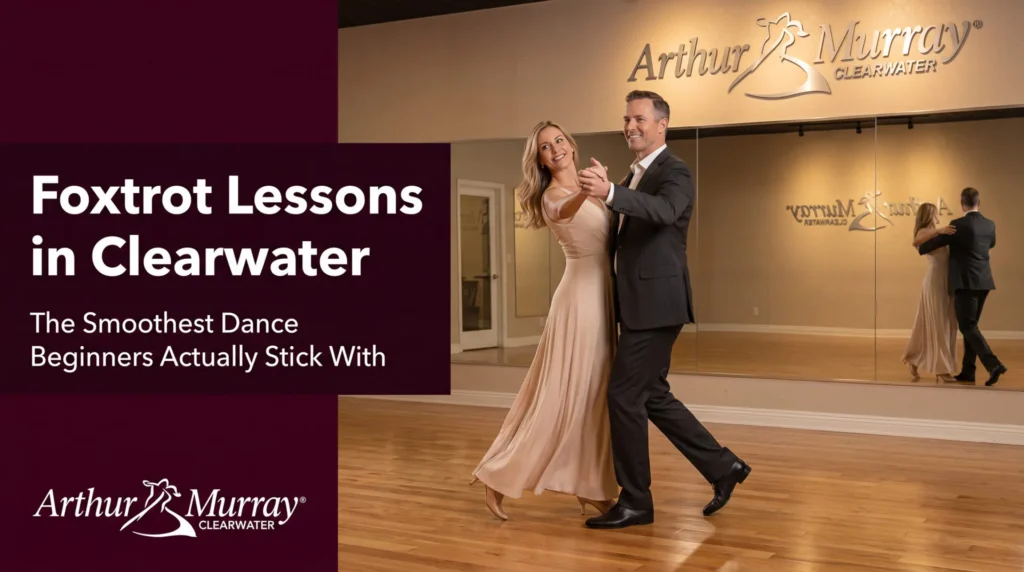
If you’ve ever watched a couple glide across a dance floor and thought it looked impossibly graceful — like movement that requires years of training just to fake — there’s a good chance you were watching the foxtrot. And there’s a good chance you were wrong about the years part.
The foxtrot is one of the most accessible dances in the ballroom world. It’s also one of the most useful ones you can learn, which is a rare combination. Most dances reward you either quickly or deeply. The foxtrot does both, and that’s a big part of why Arthur Murray students who start with it tend to stay with it long after they’ve added other styles to their repertoire.
What Makes the Foxtrot Different
The foxtrot is a smooth ballroom dance — meaning it travels across the floor with a flowing, continuous quality rather than staying in one spot or bouncing vertically. It’s danced in a closed partner hold, with graceful walking steps and gliding turns set to a comfortable four-count rhythm. The tempo is relaxed enough for beginners to absorb the timing without rushing, but the movement has enough elegance to feel genuinely satisfying from very early in the learning process.
What sets it apart from most other ballroom styles is its versatility. The foxtrot adapts beautifully to an enormous range of music — jazz standards, big band, contemporary pop ballads, Frank Sinatra, Michael Bublé, and nearly anything written in 4/4 time at a moderate tempo. That means once you learn it, you can actually use it in the real world. At weddings, on cruises, at charity galas, at any social event where a band is playing and the floor is open — the foxtrot is the dance that keeps showing up. It isn’t a specialty style you pull out for specific occasions. It’s a working dance, and students who know it rarely feel caught off guard.
The technique is built around three foundational qualities:
- Posture
- Connection with your partner
- Smooth weight transfer
None of these require athleticism or flexibility. They require awareness and practice — two things any committed student can develop regardless of age or background.
Why Beginners Respond So Well to It
A lot of new students who walk into Arthur Murray Clearwater expecting to start with salsa or swing end up falling hardest for the foxtrot. It surprises them every time, and the reason is almost always the same: the foxtrot gives you something that looks and feels like real dancing within just a few lessons.
Other styles have a longer runway before they start feeling natural. Latin dances require hip action that takes time to develop. Swing has syncopated rhythms that can trip up students who are still internalizing basic timing. The foxtrot’s walking foundation means that the very first thing you practice — walking in frame with a partner — already resembles the finished product. You aren’t doing drills that will eventually turn into dancing somewhere down the road. You’re dancing from nearly the first lesson.
That early sense of competence matters more than most people realize. Students who feel capable keep coming back. Students who feel lost often don’t. Arthur Murray’s structured curriculum is designed to build on those early wins, layering footwork patterns, turns, and directional variations onto the solid foundation the foxtrot provides — so every lesson connects to the one before it rather than starting from scratch.
The Foxtrot and Social Dancing in Clearwater
Clearwater’s social scene rewards people who know the foxtrot. The Tampa Bay area has no shortage of weddings, resort events, dinner cruises, and charity evenings where the music skews toward the kind of standards and contemporary ballads the foxtrot fits perfectly. Students who commit to learning it find that the investment pays off in real, tangible moments — not just in lessons but in the situations the lessons were preparing them for.
At Arthur Murray Clearwater, students get regular opportunities to apply what they’re learning through studio practice parties and social dance events. These aren’t performances or recitals. They’re informal evenings where students dance in a relaxed setting alongside others at various stages of their own journey — exactly the low-pressure environment that converts technique into genuine social confidence. The foxtrot is almost always on the floor at these events, which gives students a reliable, comfortable style to return to as they continue building their overall dance vocabulary.
What Foxtrot Lessons Look Like at Arthur Murray
Your first foxtrot lesson begins with connection — literally. Your instructor will establish the dance hold and help you understand how two people communicate through it. This is the part that surprises most beginners: the lead and follow in partner dancing isn’t verbal. It happens through physical contact, weight shifts, and intention. Learning to send and receive those signals is one of the most interesting parts of ballroom dance, and the foxtrot introduces it in a way that’s clear and completely unintimidating.
From there, the lesson moves into the basic step — a pattern of slow and quick counts that forms the rhythmic foundation of everything that follows. Once you have that, your instructor begins building:
- Forward and backward movements
- Side steps
- Turning patterns
- Variations that open up the dance floor rather than keeping you confined to a small patch of it
Every element connects back to what came before, so nothing appears without context.
Arthur Murray’s curriculum maps all of this progressively. Private foxtrot lessons move at your pace specifically. If you want to spend extra time on a particular concept before advancing, that’s not falling behind — that’s learning correctly. Instructors at Arthur Murray Clearwater are trained to read where a student is and meet them there, not push students through material on a fixed schedule regardless of whether it’s landed.
Is the Foxtrot Right for You?
Honestly, it’s the right dance for almost anyone. It works equally well for students who come in solo and for couples learning together. It suits virtually every age — the mechanics are physically accessible, the tempo is never rushed, and the elegance of the style scales with the student rather than demanding it upfront. Students who are drawn to classical music and traditional dancing find it immediately appealing. Students who came in expecting to only care about Latin styles frequently discover they love it too.
The one thing worth knowing: the foxtrot rewards patience. It has a polish ceiling that’s genuinely high, meaning there is always another layer of refinement available to students who want it. If you’re the kind of person who enjoys mastering something deeply rather than sampling a little of everything, the foxtrot will hold your attention for a long time. If you prefer variety, it works beautifully as an anchor style while you explore others. Either way, it’s a remarkably strong place to begin.
People Also Ask: Foxtrot Lessons in Clearwater
Is the foxtrot a good dance for beginners?
Yes — it’s widely considered one of the most beginner-accessible ballroom styles. Its walking-based foundation gives new students a sense of real dancing quickly, and the tempo is comfortable enough to focus on technique without feeling rushed.
What kind of music is the foxtrot danced to?
The foxtrot adapts to a wide range of music — jazz standards, big band, contemporary ballads, and most songs written at a moderate tempo in 4/4 time. It’s one of the most versatile social dances precisely because it works across so many musical settings.
Do I need a partner for foxtrot lessons?
No. Arthur Murray instructors partner with you in private lessons. If you take group classes, partners rotate throughout the session. Many students learn the foxtrot completely solo before bringing a partner in later.
How long does it take to learn the foxtrot?
Most students develop a confident basic foxtrot within the first several lessons. Social-level comfort — where you can dance at a wedding or event without feeling lost — typically comes within a few months of consistent practice. The foxtrot also has significant depth for students who want to advance further over time.
How is the foxtrot different from the waltz?
Both are smooth ballroom styles that travel across the floor, but they differ in timing and feel. The waltz uses a three-count rhythm with a distinctive rise-and-fall quality. The foxtrot uses a four-count pattern with a smoother, more walking-based movement. The foxtrot is generally considered more versatile for social dancing because of how widely it adapts to different music.
Can seniors learn the foxtrot?
Absolutely. The foxtrot’s deliberate tempo and low-impact movement make it one of the most recommended ballroom styles for older adult students. It builds balance and posture in a way that’s physically accessible at any age.
Ready to Try Foxtrot Lessons in Clearwater?
Arthur Murray Clearwater offers a free introductory lesson for new students — a no-pressure way to step onto the floor, meet an instructor, and find out what the foxtrot actually feels like when someone who knows it starts teaching it to you.
Reach out to Arthur Murray Clearwater to ask about the current intro offer and take the first step.