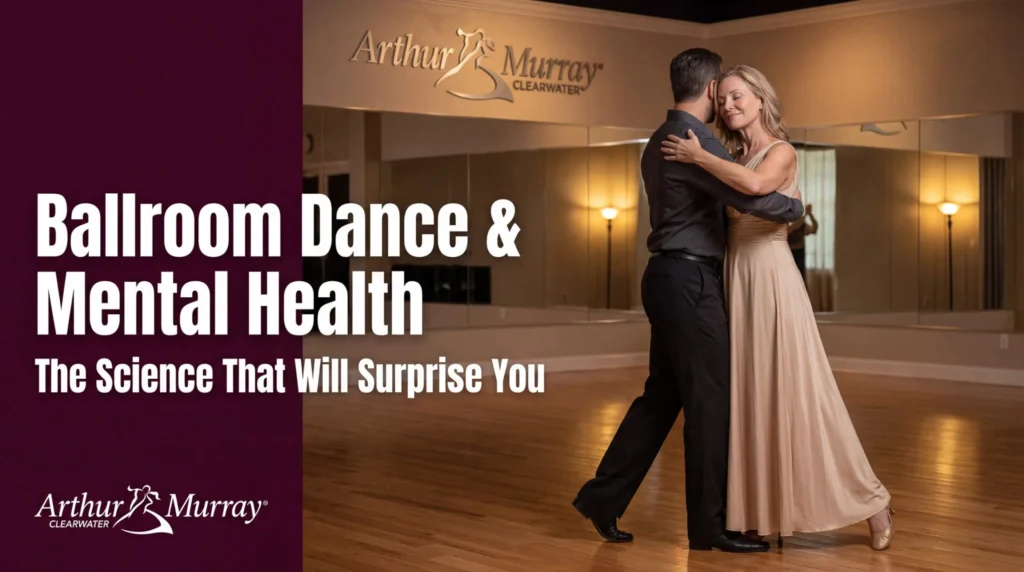
Most people who start dance lessons come in looking for something physical — a way to move, a skill to build, an activity that doesn’t feel like going to the gym. What they don’t expect is what happens to everything else. The sleep that gets better. The anxiety that quietly loosens its grip. The mood that lifts on lesson days in a way that’s hard to explain but impossible to ignore.
This isn’t coincidence, and it isn’t placebo. The mental health benefits of ballroom dance are among the most well-documented outcomes in movement science — and the research is considerably more specific, and more striking, than most people realize.
What the Research Actually Says
The study that gets cited most often in this conversation is a 21-year longitudinal study published in the New England Journal of Medicine that examined which leisure activities reduced the risk of dementia in older adults. The researchers tracked physical activities including swimming, cycling, golf, and tennis, alongside cognitive activities like reading, crossword puzzles, and playing musical instruments. Dancing was the only physical activity in the entire study associated with a reduced risk of dementia. Not one of the best — the only one.
The reason, researchers believe, is the particular combination of demands that partner dancing places on the brain simultaneously. You’re processing music and rhythm. You’re making split-second decisions about footwork and direction. You’re reading your partner’s physical cues and responding to them in real time. You’re retrieving movement sequences from memory while adapting them to a live, changing situation. No other common physical activity stacks that many cognitive layers at once, and that multi-channel engagement appears to be what makes the difference. The brain, like any other system, strengthens under complex, varied demand — and partner dancing delivers that demand in a way that a lap pool or a treadmill simply cannot.
Beyond dementia research, studies on dance and mental health have documented:
- Meaningful reductions in symptoms of depression and anxiety
- Improvements in self-esteem and body image
- Increases in overall life satisfaction
A 2007 study in the American Journal of Dance Therapy found that ballroom dancing in particular produced significant reductions in perceived stress and significant increases in positive affect — and that these changes persisted beyond the dance session itself, not just during it.
Why Ballroom Dance Specifically Produces These Outcomes
It matters that we’re talking about ballroom dance and not movement in general, because the specific elements of partner dancing are what drive most of the psychological benefit.
The social dimension is enormous. Loneliness and social isolation are among the most significant predictors of depression and cognitive decline in adults, and they’re increasingly recognized as public health concerns rather than personal struggles. Partner dancing addresses isolation in a direct, embodied way that most other activities don’t. Every lesson, every group class, every practice party involves physical presence with another person — eye contact, touch, real-time nonverbal communication. That’s not a trivial thing. Human beings are wired for exactly this kind of contact, and in a world where more and more interaction happens through screens, the experience of being genuinely present with another person carries unusual weight.
The mastery dimension matters too. One of the most reliable predictors of wellbeing across psychological research is the sense that you are learning and improving at something meaningful. Ballroom dance is a skill with genuine depth — there is always something more to refine, always a next level of quality to pursue. Students who engage with that process consistently report a sense of purpose and forward momentum that carries into other areas of their lives. It’s not that dancing fixes everything. It’s that the experience of becoming better at something, week after week, in a domain that connects to music and beauty and human connection, produces a quality of engagement that’s harder to manufacture elsewhere.
There’s also the music itself. Decades of neurological research have established that music activates more areas of the brain simultaneously than nearly any other stimulus — and that moving to music compounds that activation in ways that listening alone doesn’t produce. When you dance, you’re not just hearing the rhythm. You’re embodying it, interpreting it, expressing it through movement with another person. The neurological experience of that is meaningfully different from sitting in a concert hall, and the emotional and cognitive benefits reflect that difference.
What Students at Arthur Murray Clearwater Notice
The research is compelling, but the lived experience is what actually brings people through the door — and what keeps them coming back.
Students at Arthur Murray Clearwater regularly describe their lessons in language that goes well beyond the physical. They talk about lessons as the part of the week they look forward to most. They describe a quality of presence during a lesson — a state of focus where the usual mental noise simply doesn’t have room to operate — that resembles what psychologists call flow. They talk about confidence that started on the dance floor and gradually extended into how they carry themselves in professional settings, in social situations, in their own sense of who they are.
One of the reviews on the Arthur Murray Clearwater website captures something important: a student who came in solo, with no dance background, and found not just instruction but a community. That social layer — the other students, the instructors who know your name, the practice parties where faces become familiar — is part of the mental health picture in ways that a single lesson can’t fully reveal. It takes a few months to experience what Arthur Murray Clearwater actually is as a community, and students who get there tend to stay.
None of this means ballroom dance is therapy, and it would be irresponsible to frame it that way. If you’re dealing with significant depression, anxiety, or other mental health challenges, professional support is the right first call. What dance offers is something adjacent but distinct — a genuine, research-supported contributor to the kind of life conditions that support mental wellness: social connection, physical activity, cognitive challenge, mastery, joy, and the particular aliveness that comes from moving to music with another person.
The Case for Starting Sooner Rather Than Later
One of the more interesting findings in the dementia research is that the protective effect of dancing appears to be cumulative. The longer someone has been dancing, and the more consistently they’ve engaged with it, the stronger the association with cognitive protection. This isn’t a benefit you bank by taking a few lessons. It’s one that compounds over time, which means the calculus around when to start is actually fairly simple: earlier is better.
For adults in Clearwater who’ve been thinking about trying dance lessons — who’ve had it on a list somewhere, or brought it up in passing and then let the moment pass — this is worth sitting with. The mental and cognitive benefits of ballroom dance don’t require athletic ability, competitive ambition, or a partner. They require showing up consistently and engaging genuinely with the process. Arthur Murray Clearwater’s introductory offer exists precisely to make that first step as easy as possible.
The science has been making the case for years. At some point, the more interesting question isn’t whether ballroom dance is good for you. It’s why you’re still waiting to find out for yourself.
People Also Ask: Ballroom Dance and Mental Health
Is ballroom dancing good for mental health?
Yes. Research consistently links ballroom dancing to reduced symptoms of depression and anxiety, improved self-esteem, and greater overall life satisfaction. The combination of social connection, physical movement, music, and cognitive challenge makes it one of the more complete activities for psychological wellbeing available to adults.
Can dancing reduce stress and anxiety?
Yes. Multiple studies have found that dancing produces significant reductions in perceived stress and anxiety, and that these effects persist beyond the dance session itself. The focused, present-moment nature of partner dancing is particularly effective at interrupting chronic stress patterns.
Why is dancing good for the brain?
Partner dancing requires simultaneous processing of music, movement, memory, spatial awareness, and real-time social cues — engaging more areas of the brain at once than most other activities. This multi-channel demand appears to support neuroplasticity and cognitive resilience.
Does ballroom dancing help with depression?
Research suggests it can. Studies have found meaningful improvements in mood and reductions in depressive symptoms among adults who engage in regular partner dancing. The social dimension of ballroom dance — which addresses isolation, a significant contributor to depression — is considered part of the mechanism. Ballroom dance is not a substitute for professional mental health care, but it is a meaningful complement to it.
Is dancing good for older adults’ mental health?
Particularly so. A landmark study found dancing was the only physical leisure activity associated with reduced dementia risk in a 21-year study. For older adults, the combination of cognitive challenge, social engagement, and physical activity that partner dancing provides makes it one of the most recommended activities for healthy aging.
Do I need to be in good mental health to start dance lessons?
No. Many students come to Arthur Murray Clearwater precisely because they’re looking for something that lifts their mood, reduces stress, or helps them build social connection. The studio environment is welcoming and nonjudgmental, and instructors are experienced working with students at all stages of life.
Ready to Experience It for Yourself?
Arthur Murray Clearwater offers a free introductory lesson for new students — a low-pressure way to step onto the dance floor, meet an instructor, and find out firsthand what all the research has been pointing toward.
Reach out to Arthur Murray Clearwater to schedule yours.