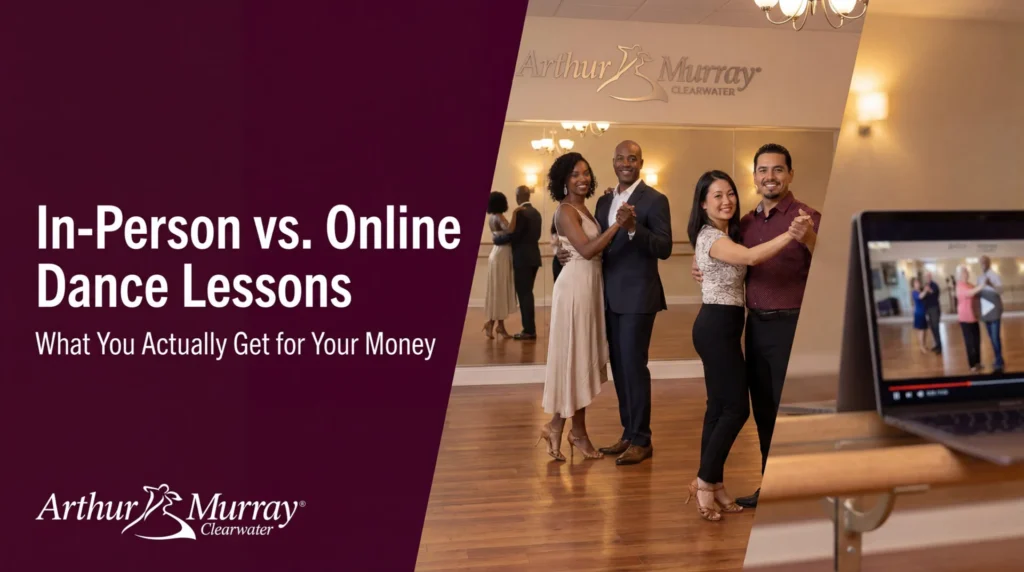
The internet has made it possible to learn almost anything from a screen. Languages, instruments, cooking techniques, coding — all of it available on demand, often free, often surprisingly good. So it’s a completely reasonable question: can you learn to dance the same way?
The short answer is that online resources can introduce you to dance concepts, and for certain purposes they’re genuinely useful. The longer answer is that partner dancing specifically depends on something a screen cannot deliver — and understanding what that something is will save you a lot of frustrated practice sessions before you figure it out the hard way.
This isn’t an argument against the internet. It’s an honest look at what each format actually produces, so you can make an informed decision about where to put your time and money.
What Online Dance Lessons Can Do
Online dance content has real value, and it’s worth being accurate about that before explaining where it falls short. YouTube channels, streaming platforms, and subscription dance apps offer clear demonstrations of footwork patterns, timing breakdowns, and style-specific technique. For a motivated self-learner who wants to understand what a foxtrot basic looks like, or get a feel for the difference between salsa and bachata before committing to lessons, video content is a legitimate starting point.
Online resources are also useful as supplemental practice material for students who are already taking in-person lessons. Watching a demonstration of a pattern you learned in class can reinforce muscle memory, clarify a detail you didn’t fully absorb in the moment, and give you something to work with between sessions. Used that way — as a complement to real instruction — online content earns its place.
What it cannot do is teach you to dance.
The Feedback Problem
Here is the core issue, and it’s worth stating plainly: dancing is a physical skill that requires correction to develop correctly. Video instruction delivers information. It cannot deliver feedback. Those are not the same thing, and in a motor skill context, the difference between them determines whether you actually improve.
When you watch a video and attempt to replicate what you see, you have no way of knowing whether what your body is doing matches what the screen is showing. You feel like you’re doing it right — most people do, most of the time — but feeling correct and being correct are entirely different things in physical skill development. The habits you build in those early sessions, without correction, become the habits you carry forward. And habits built on incorrect technique are significantly harder to undo than they would have been to build correctly in the first place.
Any experienced dance instructor will tell you that students who arrive having taught themselves from videos often require more remedial work than complete beginners who have never tried at all. The beginner has nothing to unlearn. The self-taught student has ingrained patterns that actively interfere with correct development — a turned-out foot that should be parallel, a hunched frame that should be upright, a timing interpretation that’s close enough to feel right but wrong enough to prevent advancement.
At Arthur Murray Clearwater, instructors don’t just teach steps. They watch you execute them, identify precisely what’s working and what isn’t, and correct it in real time. That feedback loop — do something, receive specific correction, adjust, improve — is how physical skills are actually acquired. It is not something any video platform has found a way to replicate.
The Partner Problem
Partner dancing introduces a second dimension that online instruction simply cannot address: another person. Ballroom dance is not a solo activity performed in parallel. It is a communication system between two bodies, built on lead and follow signals that are physical, subtle, and entirely invisible on a screen.
A video can show you what a lead looks like from the outside. It cannot give you the experience of feeling what a clear lead communicates through a dance hold, or what a muddled one leaves your partner guessing about. That tactile vocabulary — learning to send and receive intention through physical connection — is something that can only be developed through actual partner work with someone who knows how to teach it.
When you take private lessons at Arthur Murray Clearwater, your instructor is your partner. They are simultaneously dancing with you and teaching you how to dance — correcting your frame, guiding your weight transfer, giving you the experience of what correct lead-and-follow actually feels like from the inside rather than what it looks like from the outside. That experience is irreplaceable. It’s also the thing that makes the difference between someone who has watched a lot of dance videos and someone who can actually dance at a wedding, a social event, or a practice party without thinking their way through every measure.
The Motivation Problem
There’s a third dimension that doesn’t get discussed as often but matters enormously in practice: accountability and environment.
Online learning is self-directed, which sounds like a feature but frequently functions as a bug. Self-directed learning requires consistent self-motivation, a structured approach to progression, and the discipline to practice regularly without external accountability. For most adults managing full schedules, that combination is harder to sustain than it sounds. The flexibility of learning on your own schedule easily becomes the flexibility to skip this week, and the next, and the one after that.
In-person lessons at Arthur Murray Clearwater introduce a structure that removes most of that friction. You have an appointment. An instructor is expecting you. The studio has an energy — other students working, music playing, a community of people engaged in the same pursuit — that makes showing up easy and makes staying home feel like a genuine loss. Students who take lessons consistently almost universally report that the scheduled, social nature of in-person instruction is a significant part of why they actually progressed, because the environment made consistency the path of least resistance rather than the path of most effort.
Progress in dance, as in most skill domains, is almost entirely a function of consistent, quality practice over time. In-person lessons at a structured studio are designed to produce exactly that. A YouTube playlist is not.
What the Cost Comparison Actually Looks Like
It’s tempting to frame this as a money question — online content is cheap or free, studio lessons cost more, so the frugal choice is obvious. But that framing only holds if both options produce comparable results, and the evidence strongly suggests they don’t.
The more accurate framing is return on investment. If online instruction produces slow progress, ingrained bad habits, and an eventual plateau that requires remedial correction before advancement is possible, its low cost is not actually an advantage. If in-person instruction at a studio like Arthur Murray Clearwater produces real, measurable progress, correct foundational technique, and a skill you can actually use in social settings — the investment looks considerably different when evaluated against what it delivers.
Most students who try both, in either order, reach the same conclusion: online content informed them, but in-person instruction taught them. The distinction is not subtle once you’ve experienced both sides of it. Arthur Murray Clearwater’s introductory offer is designed specifically to let prospective students experience the in-person difference at a minimal upfront cost — which is the most direct way to answer the question this article is raising.
People Also Ask: In-Person vs. Online Dance Lessons
Can you really learn to dance from YouTube?
You can learn about dance from YouTube — footwork patterns, timing concepts, style differences. What you cannot develop is correct technique, because technique requires feedback and correction that video cannot provide. Most students who rely solely on online content develop habits that need to be unlearned before real progress is possible.
Is it worth paying for in-person dance lessons?
For partner dancing specifically, in-person instruction is the only format that can develop the tactile lead-and-follow skills the dance requires. The feedback, partner work, and structured progression that in-person lessons provide produce results that online content cannot replicate. Evaluated on what each format actually delivers, in-person lessons are the stronger investment.
What can’t you learn about dancing online?
Partner connection and lead-and-follow technique cannot be learned from video alone — they require a real partner and a trained instructor who can correct what you’re doing in the moment. Correct physical technique in general is very difficult to develop without someone watching you and providing specific feedback.
Are online dance apps good for beginners?
They can introduce concepts and build basic familiarity with rhythms and styles. For complete beginners, they’re most useful as supplemental material alongside real instruction — not as a substitute for it.
How quickly do you progress with in-person dance lessons vs. online?
Students in structured in-person programs consistently progress faster than self-taught online learners, because correct technique is established from the beginning rather than having to be rebuilt after bad habits form. The feedback loop in private instruction compresses the learning timeline significantly.
Does Arthur Murray offer a trial lesson for new students?
Yes. Arthur Murray Clearwater offers a free introductory lesson for new students — a straightforward way to experience in-person instruction and evaluate the difference firsthand before making any larger commitment.
The Honest Bottom Line
Online dance content is a useful tool for people who know how to use it. It’s a poor substitute for instruction. For partner dancing specifically — where technique, tactile communication, and real-time feedback are the core of what you’re learning — there is no digital workaround for being in the room with a skilled instructor who is watching you, correcting you, and dancing with you.
Arthur Murray Clearwater offers a free introductory lesson for new students. If you’ve been on the fence between the screen and the studio, that lesson will answer the question more efficiently than any comparison article ever could.
Reach out to Arthur Murray Clearwater to schedule yours.