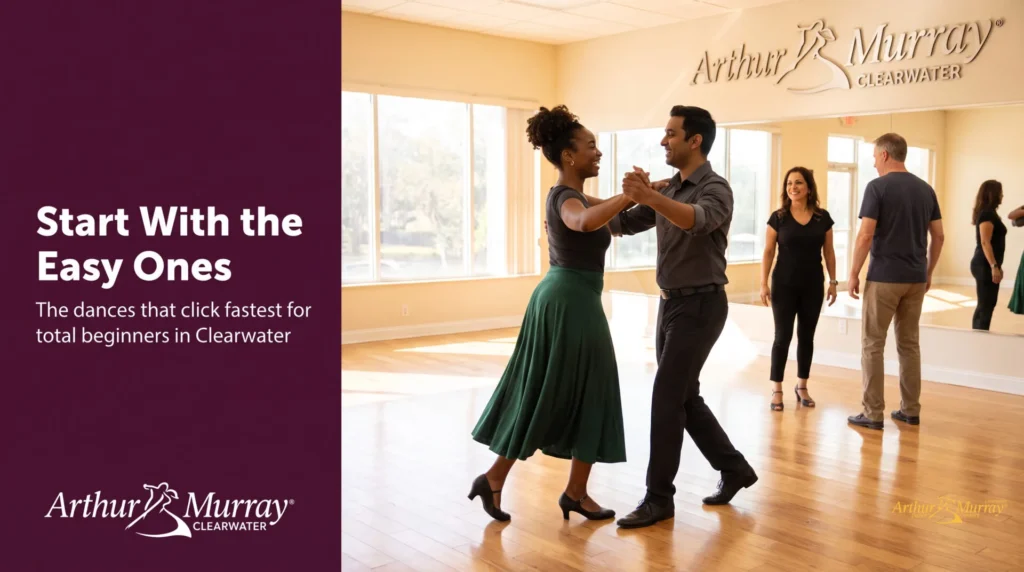
The Easiest Dances to Learn
-
Easiest Dance Overall: Waltz is the most common first dance for adults with no experience, because the box pattern repeats and the count stays the same all the way through.
-
The Beginner Five: Waltz, Rumba, Foxtrot, Cha Cha and Swing are the styles most studios teach first, and they cover almost every song you will hear at a Tampa Bay wedding or social night.
-
Why They Are Easy: Each is built on a small number of basic steps that repeat, so you spend your first hour learning rhythm and partnership rather than memorizing choreography.
-
What Actually Slows Beginners Down: Shoes with rubber soles, trying to learn from video alone, and picking a fast dance first. All three are fixable in one lesson.
-
Where To Start Locally: Arthur Murray Dance Centers Clearwater on US Highway 19 N teaches all five in structured beginner programs, starting with a complimentary introductory lesson of about 30 minutes that needs no partner and no experience.
A couple walks into the studio on US Highway 19 N on a Tuesday evening. They have a wedding in Dunedin in five months, one of them has never danced a step, and the other took two lessons in college and remembers nothing. Their first question is not about price or schedule. It is a version of the same question almost every new adult student asks: which dance is the easiest one to start with?
That question has a real answer, and it is not a matter of opinion. Some partner dances are built on two or three repeating patterns and a steady count. Others ask you to change direction, change rhythm and change frame all in the same measure. If you begin with the first group, you will be dancing socially within weeks. If you begin with the second, you may decide dancing is not for you, which would be the wrong conclusion drawn from the wrong starting point.
This article ranks the easiest dances to learn for complete beginners, explains what makes each one forgiving, and lays out a practical starting path for adults in Pinellas County and greater Tampa Bay.
What Is the Easiest Dance to Learn for Beginners?
The Short Answer:
Waltz is the easiest dance to learn for most complete beginners. It uses a repeating box pattern in a steady three-count, so the rhythm never changes underneath you. Rumba, Foxtrot, Cha Cha and Swing follow closely behind. Supadance notes the waltz box is repetitive and easy to count, and Fred Astaire Dance Studios lists waltz, rumba, cha-cha and foxtrot as the styles most commonly taught first.
Why the Waltz Comes First
The waltz gives you one job at a time. The music counts one-two-three, over and over, and the basic figure is a box: forward, side, together, then back, side, together. Nothing about the timing shifts on you mid-pattern.
That predictability matters more than beginners expect. Most of the discomfort in a first lesson comes from not knowing what is about to happen. When the count is constant and the shape is a square, your attention is available for the things that actually make dancing feel good, like posture, connection with your partner, and moving to music instead of counting at it. The slower waltz lessons in Clearwater route is also the most common wedding-song fit, since a large share of first-dance songs sit comfortably in waltz timing.
The Five Easiest Dances, Ranked Simplest First
-
1. Waltz: A rise-and-fall box in three-count time. The most forgiving entry point because the rhythm is unbroken and the pattern is symmetrical. Best for wedding first dances and any slow, romantic song.
-
2. Rumba: A slow four-count box danced with a hip action rather than a rise. Same shape as waltz, different timing, so it is often the second dance taught. Fits nearly every slow Latin or pop ballad. See rumba lessons for beginners.
-
3. Foxtrot: A smooth walking dance in four-count time, built on slow and quick steps. It looks like elegant walking because that is essentially what it is. The most useful dance at formal events and country club receptions. Start with foxtrot instruction in Clearwater.
-
4. Cha Cha: A four-count Latin dance with a small triple step that gives it its name. Slightly harder than rumba only because the tempo is faster, not because the pattern is more complex. Learn the cha cha basic and you have a dance for most upbeat Latin tracks.
-
5. Swing: A bouncy six-count dance for classic rock, blues and big band. It ranks fifth because the rhythm has a triple-step feel, but it becomes the most-used social dance for many students within their first year. Explore swing dance basics.
What Makes a Dance Easy in the First Place
Difficulty in partner dancing comes down to three things: how many basic patterns you must hold in memory, whether the rhythm stays constant, and how fast the music moves. A dance that scores well on all three is a beginner dance. Arthur Murray Dance Now describes the best dances for absolute beginners as those with minimal steps, some built on as few as two basics.
This is why Viennese Waltz, Quickstep and Samba are not on the list above. They are wonderful dances and our students learn them, but they move quickly and change direction often. Starting there is like learning to drive on the Courtney Campbell Causeway at rush hour instead of an empty parking lot.
Dances That Look Easy But Are Not
-
Salsa: The basic step is simple, but the tempo is fast and the turn patterns arrive early. Many students love it and start there anyway, and that is fine with an instructor guiding the pace. See the salsa and bachata comparison if you are choosing between the two.
-
Argentine Tango: Beautiful and deeply improvised. There is no fixed basic pattern to fall back on, which is exactly what a nervous beginner needs on night one.
-
Bachata: Genuinely beginner-accessible in its basic form, and often taught early. It ranks just outside the top five only because its side-to-side basic gives fewer options at a mixed ballroom event than waltz or foxtrot do.
-
Merengue: Arguably the simplest pattern of all, a marching step in two-count time. It is a genuine easy win, though it has a narrower music range than the five ranked above.
-
Hustle: Deceptive. The disco-era feel makes people assume it is casual, but the count runs against the music in a way that takes a few lessons to internalize.
When This Ranking Does Not Apply
The ranking assumes you have no specific goal yet. If you do, the goal outranks the difficulty list every time.
An engaged couple with a Nightclub 2-Step song should learn Nightclub 2-Step, not waltz. A student who fell in love with a Bachata track at a St. Petersburg social should start with Bachata. Motivation is a bigger factor in progress than pattern count, and a dance you actually want to do will carry you through the awkward first weeks. That is why our first lesson begins with questions rather than steps.
How Adults in Pinellas County Should Start Learning Their First Dance
The Short Answer:
Start with one private introductory lesson, choose one dance from the beginner five, and wear shoes with a smooth sole. At Arthur Murray Dance Centers Clearwater the first lesson runs about 30 minutes, requires no partner and no experience, and begins with the instructor asking about your goals and preferred style before guiding you through a few basic steps.
What Actually Happens in a First Lesson
Nothing is sprung on you. According to the Arthur Murray International studio page for Clearwater, the format is a short conversation about your goals, interests and preferred dance style, followed by a few basic steps with an instructor. You are not put on a floor with strangers and you are not asked to perform.
Most people arrive expecting to be assessed. What actually happens is closer to a fitting. The instructor is figuring out which dance suits your music, your body and your timeline, which is why the questions come before the steps. You can read more about how our teaching method works before you come in.
Your First Four Weeks, In Order
-
Week One — One Dance, One Pattern: You learn a single basic and how to keep time with it. The goal is not variety. The goal is that the pattern stops requiring conscious thought.
-
Week Two — Adding the Partner: Frame, lead and follow. This is where most beginners have the moment where dancing suddenly feels like a shared activity rather than two people doing steps near each other.
-
Week Three — A Second Pattern and a Turn: Now you have something to switch between, which is what makes dancing look like dancing rather than repetition.
-
Week Four — Dancing to Real Music: Songs you did not practice to, at a tempo you did not choose. Many students take this step at a studio practice party, which is lower pressure than a public venue.
What To Wear So the Floor Works With You
Shoes are the one piece of equipment that genuinely affects your first lesson. Arthur Murray Dance Now advises that men do well in leather-soled dress shoes, jazz shoes, or loafers and Oxfords with a harder sole, and explains the mechanism plainly: soles with too much grip cause the foot to stop before the body does, which throws off balance during pivots.
Fred Astaire Dance Studios makes the same point from the other direction, recommending against sneakers because they make it hard to spin and turn, with leather or suede soles as the alternative. You do not need to buy dance shoes before your first lesson. You do need to leave the running shoes at home.
Private Lessons, Group Classes and Practice Parties Compared
-
Private Lessons — Fastest Correction: One instructor, one focus, immediate feedback on your specific habits. This is where technique gets built and where nervous beginners are most comfortable starting.
-
Group Classes — Repetition and Company: You practice the same figure many times with different partners, which builds adaptable leading and following. Our group dance classes reinforce what the private lesson introduced.
-
Practice Parties — The Real Test: Social floor, real music, no instruction. This is where the skill becomes yours rather than something you can do in a lesson.
-
All Three Together — How the System Works: The interrelated approach exists because each format fixes what the others cannot. Skipping the social component is the most common reason students plateau.
Why Ballroom Is Worth the Effort Beyond the Dance Floor
There is a physical and cognitive case for social dancing that goes past the wedding or the party. The Compendium of Physical Activities MET table rates slow ballroom dancing at 3.0 METs and fast ballroom at 5.5 METs, which places social ballroom in the moderate-intensity activity band.
The cognitive side has drawn research attention as well. A 2025 Bayesian network meta-analysis published in Archives of Gerontology and Geriatrics found that among dance interventions in older adults, ballroom dancing was the only style that significantly improved cognitive function. A separate randomized study of 25 adults over age 65, summarized in The Conversation, compared six months of twice-weekly social ballroom classes against twice-weekly treadmill walking and reported improved cognitive function and reduced brain atrophy among participants at increased risk of dementia. For active seniors across Pinellas County, that is a meaningful reason to start with an easy dance rather than no dance.
Local Starting Points by Goal
-
Engaged Couples: Bring your song first. Most first-dance songs fit waltz, rumba or foxtrot, and our wedding first dance preparation works backward from the recording and the ceremony date.
-
Couples Wanting Connection: Rumba or foxtrot. Both are slow enough to talk through and built entirely on partnership rather than flash.
-
Active Seniors: Waltz and foxtrot, in the slow-tempo range, with swing added once balance and timing feel automatic.
-
Social Dancers Drawn to Latin: Rumba and cha cha first, then salsa and bachata. The Latin foundation transfers, and it transfers faster than starting with salsa cold.
-
Solo Adults With No Partner: Any of the five. No partner is required to begin, and rotating partners in class builds a more adaptable lead and follow than practicing with one person only.
The Studio Behind the Method
Arthur Murray Dance Studios was founded in 1912 and now operates more than 300 studios across over 20 countries, according to a company release issued in January 2026. That scale matters for one practical reason: the beginner syllabus has been refined by more than a century of teaching adults who walked in saying they had two left feet.
Locally, the Clearwater studio sits on US Highway 19 N and serves students from Dunedin, Safety Harbor, Largo, Palm Harbor and across the bay, with an affiliated Tampa and Hyde Park studio for students on the other side of the Courtney Campbell. Every style listed in this article appears in the beginner programs we offer.
Key Takeaways
-
Waltz Is the Simplest Start: A repeating box in an unchanging three-count makes it the easiest dance to learn for most complete beginners.
-
Five Dances Cover Most Music: Waltz, rumba, foxtrot, cha cha and swing between them handle nearly every song you will meet at a Tampa Bay wedding or social event.
-
Ease Comes From Structure, Not Talent: Few patterns, steady rhythm and moderate tempo are what make a dance beginner-friendly. None of that depends on natural coordination.
-
Your Goal Beats the Ranking: If you have a specific song or a specific event, learn the dance that fits it. Motivation moves you faster than a shorter step count does.
-
Start With One Short Lesson: The introductory lesson at the Clearwater studio runs about 30 minutes, needs no partner and no experience, and begins with questions about your goals rather than a test.
Start Your First Dance Lesson in Clearwater
Pick one dance from the five, wear a smooth-soled shoe, and give it thirty minutes. That is the entire commitment required to find out whether the waltz box or the swing triple is the one that clicks for you. Nobody at the studio expects you to arrive knowing anything.
Arthur Murray Dance Centers Clearwater is at 25032 US Highway 19 N, serving Pinellas County and greater Tampa Bay. Use our contact page to book your first lesson or call (727) 485-9169 and tell us what song you have in mind.
External References
-
Arthur Murray International — the parent organization behind the teaching method used at the Clearwater studio.
-
National Dance Council of America — the governing body for competitive and syllabus ballroom dance standards in the United States.
-
USA Dance — the national member organization for social and DanceSport ballroom dancing.