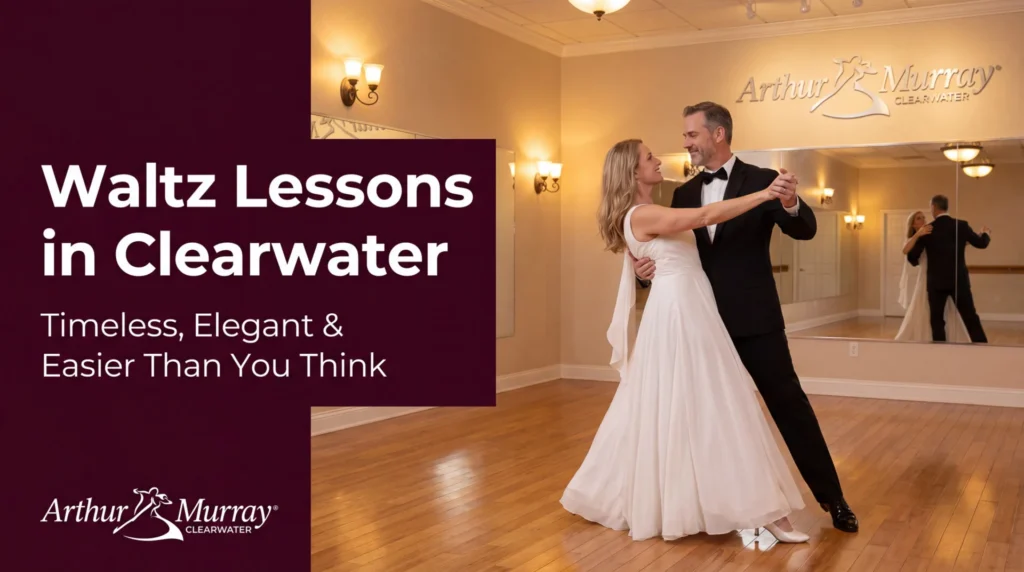
There’s a reason the waltz has survived for more than two centuries while every other dance trend from the same era has long since faded. It isn’t nostalgia. It isn’t tradition for tradition’s sake. The waltz endures because it does something genuinely rare — it makes dancers feel graceful almost immediately, and it keeps offering something more to the ones who stay with it long enough to find it.
If you’ve been curious about waltz lessons in Clearwater but assumed the dance was too formal, too complicated, or simply too old-fashioned for where you are right now, this is worth reading before you write it off.
What the Waltz Actually Is
The waltz is a smooth ballroom dance built on a three-count rhythm — one, two, three, one, two, three — with a characteristic rise and fall that gives it the floating, wavelike quality you recognize the moment you see it done well. Partners move in a closed hold, traveling across the floor in a pattern of forward and backward steps, turns, and directional changes that, at their most basic, are simpler than most beginners expect.
The rise and fall is what makes the waltz look the way it does. As dancers move through each measure of music, there’s a natural elevation on the first count and a gentle lowering through the second and third — a physical expression of the music’s own shape. Learning to let that happen naturally, rather than forcing it, is one of the more satisfying discoveries in early waltz training. When it clicks, the dance stops feeling like a series of steps and starts feeling like movement.
The music that accompanies the waltz spans an enormous range — from Strauss to modern ballads, from classical orchestrations to contemporary songs written in three-quarter time. Almost every wedding repertoire includes at least one waltz-tempo song, which makes it one of the most practically useful dances a couple can learn together. But its appeal goes well beyond weddings. The waltz is a social dance in the fullest sense, equally at home at a formal gala, a community dance event, or an Arthur Murray studio practice party.
Why the Waltz Is More Accessible Than Its Reputation Suggests
The waltz carries a certain intimidating elegance in the popular imagination — all long gowns and chandeliers and perfect posture. That image is accurate at the highest levels of ballroom competition. It is not an accurate picture of what walking into your first waltz lesson at Arthur Murray Clearwater looks like.
The foundational waltz pattern is genuinely learnable in a first lesson. The three-count rhythm is one of the most natural in Western music — humans internalize it almost instinctively. The basic box step that anchors early waltz training traces a square on the floor in a sequence that most students have moving reasonably well within the first thirty minutes of instruction. What takes time isn’t learning the waltz. It’s refining it — and that refinement is where the dance rewards patience in deeply satisfying ways.
Arthur Murray’s curriculum approaches the waltz the same way it approaches every style: progressively, with each new element connected to something the student already knows. You aren’t handed the full picture on day one and told to replicate it. You’re walked through a sequence of building blocks that compound over time, so that the elegance the dance is known for develops naturally out of solid fundamentals rather than being performed on top of shaky ones.
The Waltz as a Wedding Dance
Wedding season in the Clearwater and Tampa Bay area runs almost year-round, and the waltz is one of the most requested first dance styles Arthur Murray instructors work with couples on. There’s a reason for that. The waltz’s flowing, continuous movement photographs and films beautifully. It fills the floor in a way that looks intentional and choreographed even at a fairly basic skill level. And its tempo gives couples enough time to actually be present with each other during the dance rather than scrambling to keep up.
Couples who come to Arthur Murray Clearwater with a wedding date on the calendar typically discover two things. First, that three months of consistent private lessons produces a first dance that genuinely impresses their guests. Second, that they enjoyed the process enough to keep going after the wedding. The waltz tends to do that — it opens a door that most couples didn’t expect to want to walk through.
If a wedding is what’s bringing you to waltz lessons in Clearwater, the earlier you start the better. More time means more polish, more comfort, and more flexibility to choose the kind of choreography that actually reflects who you are as a couple rather than defaulting to whatever fits into four lessons.
Standard Waltz vs. Viennese Waltz: What’s the Difference?
This question comes up often enough that it’s worth addressing directly. Arthur Murray Clearwater teaches both, and they are genuinely distinct dances despite sharing a name and a time signature.
The standard waltz — which is what most people mean when they simply say “waltz” — is danced at a moderate tempo with the rise-and-fall technique described above. It travels across the floor at a pace that allows for deliberate footwork, turns, and partner connection. It’s the waltz that most beginners start with, and it’s the one with the broader social application.
The Viennese waltz is faster — considerably faster. It’s the waltz you see in period films and grand ballroom scenes, characterized by continuous rotating turns at a tempo that feels exhilarating once you’re comfortable with it and genuinely overwhelming if you try to start there. The Viennese waltz is typically approached after a student has solid foundations in the standard waltz, because the technique is the same but the speed demands a level of automatic competence that takes time to develop.
Most students fall in love with the standard waltz first. Some eventually find the Viennese waltz irresistible. Both are on offer at Arthur Murray Clearwater.
What Waltz Lessons Look Like at Arthur Murray Clearwater
Your first waltz lesson begins with the rhythm — not the steps. Before any footwork is introduced, your instructor will help you feel the three-count pulse of the music, because the waltz lives in that rhythm in a way that’s more intuitive than technical. Once you’re comfortable with the beat, the basic box step follows naturally.
From there, lessons move through progressive material:
- The natural turn
- The reverse turn
- Promenade positions
- Flowing combinations across the floor that start to look like the waltz you’ve always imagined
Each element builds on the last. Nothing is introduced without context, and nothing is rushed past before it’s ready to be built upon.
Private waltz lessons at Arthur Murray Clearwater move at your pace. Instructors here are trained not just in technique but in teaching — meaning they understand how to explain concepts in multiple ways until the one that works for you lands. The goal isn’t to produce dancers who can replicate a routine. It’s to develop dancers who understand the waltz deeply enough to improvise, respond, and actually enjoy themselves on any dance floor they encounter.
People Also Ask: Waltz Lessons in Clearwater
Is the waltz hard to learn?
The foundational waltz is one of the more accessible ballroom dances. The three-count rhythm is intuitive for most people, and the basic pattern can be moving well within a first lesson. Refinement — the rise and fall, the smooth rotation, the quality of partner connection — develops over time with consistent practice.
What is the difference between the waltz and the Viennese waltz?
The standard waltz is danced at a moderate tempo with a rise-and-fall technique and a mix of turning and traveling figures. The Viennese waltz is significantly faster, characterized by continuous rotating turns. Most students start with the standard waltz and progress to the Viennese waltz after building solid fundamentals.
Is the waltz a good first dance for a wedding?
Yes — it’s one of the most popular wedding first dance choices for good reason. The waltz’s flowing movement films beautifully, its tempo allows couples to be present with each other, and even a basic waltz looks elegant at a wedding reception. Arthur Murray Clearwater works with engaged couples regularly on wedding waltz choreography.
Do I need a partner to take waltz lessons?
No. Arthur Murray instructors partner with you in private lessons. Many students learn the waltz solo and bring a partner in later, or introduce a partner once they have enough foundation to make the shared learning process more enjoyable.
How long does it take to learn the waltz?
Most students develop a confident social waltz within a few months of consistent lessons. Wedding-ready choreography is typically achievable in three to four months with regular private instruction. The waltz also has significant depth for students who want to continue advancing.
What music is the waltz danced to?
The waltz is danced to any music written in three-quarter time — Strauss classics, traditional ballroom standards, and a wide range of contemporary ballads. Many popular wedding songs are in waltz tempo, which is part of why the dance has such enduring relevance.