If You’ve Spent Decades Telling Yourself You’re Not a Dancer, Here’s the Truth
That story isn’t based on evidence. It’s based on never having tried — or having tried something that wasn’t designed for you.
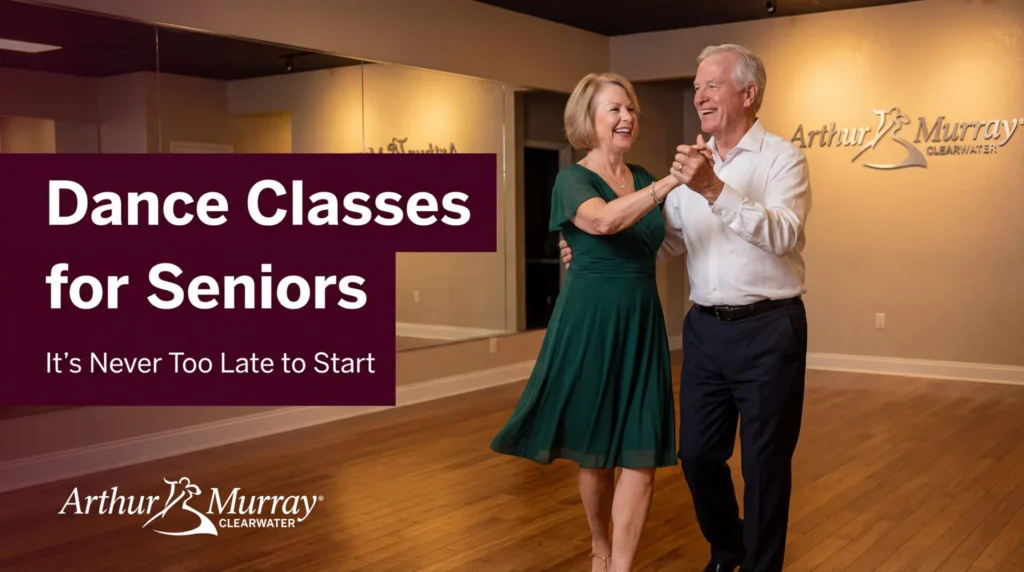
Dance classes for seniors at Arthur Murray Clearwater are specifically suited to adults who are starting fresh, returning after years away, or simply looking for a meaningful, physical activity that doesn’t feel like exercise. The students who walk in at 60, 70, or even 80 years old and discover they can actually do this — they’re not the exception. They’re the rule.
Why More Seniors Are Choosing Ballroom Dance
The conversation around healthy aging has shifted. Doctors, physical therapists, and neurologists are increasingly pointing to partner dancing — and ballroom dance in particular — as one of the most complete activities an older adult can pursue.
It’s not hard to see why. A single ballroom dance session engages your cardiovascular system, challenges your balance, exercises your memory, and gives you a reason to be socially present with another person. You’d have to combine several conventional fitness activities to get the same range of benefits.
But the clinical case isn’t actually why most seniors try it. They try it because someone they know fell in love with it, or because they’ve always wanted to, or because they’re looking for something new after retirement. The health benefits are what keep them coming back.
What Makes Senior Dance Lessons Different at Arthur Murray?
Not all dance instruction is created equal — and what works for a 28-year-old training for a competition is not what works for a 68-year-old who wants to enjoy dancing socially.
At Arthur Murray Clearwater, instructors are trained to adapt. That means:
- Pace is set by the student, not the curriculum. There’s no pressure to advance faster than feels comfortable. Some students move through material quickly; others prefer to spend more time deepening a single style before moving on. Both are valid.
- Movement is taught with the body in mind. Low-impact instruction means the footwork, posture, and partnering techniques are introduced in ways that respect where your body is today — not where it was forty years ago.
- There are no beginners who are “too far behind.” Every new student starts at the beginning regardless of age. A 70-year-old beginner and a 30-year-old beginner receive the same quality of foundational instruction. Age is not a handicap in the Arthur Murray system.
- The environment is encouraging, not competitive. The Arthur Murray studio culture is explicitly supportive. Students are not being compared to one another, and there’s no performance pressure — especially for adults who are dancing purely for the joy of it.
The Best Dance Styles for Older Adults
Several ballroom and Latin styles are particularly well-suited to seniors — either because of their tempo, their movement quality, or the social nature of how they’re danced.
Foxtrot
Smooth, flowing, and danced at a relaxed pace. The foxtrot is one of the most elegant ballroom styles and also one of the most physically forgiving for new dancers. It builds excellent posture and balance without demanding high-impact footwork.
Waltz
The waltz’s three-count rhythm has a natural, pendulum-like quality that many seniors find intuitive. It’s graceful, deliberate, and deeply satisfying once the basic movement is internalized.
Rumba
The slowest of the Latin styles, rumba focuses on connection, Cuban hip motion, and expressive movement. It’s sensual without being strenuous — a favorite among older adult students who want Latin dance without high intensity.
Bolero
Often called the “dance of romance,” bolero is danced at the slowest tempo of any competitive ballroom style. It prioritizes expression, body movement, and connection over athleticism — ideal for seniors.
Cha-Cha
For seniors who want something with more energy, cha-cha offers Latin flair at a moderate pace. The footwork is rhythmic and repetitive in a way that becomes muscle memory relatively quickly.
Your Arthur Murray instructor will help you identify which style fits your body, your goals, and what simply feels right when you’re moving.
The Cognitive Benefits of Dance for Seniors
This deserves its own section because the research is genuinely striking.
A landmark study published in the New England Journal of Medicine found that dancing was the only physical leisure activity among those studied associated with a reduced risk of dementia — outperforming swimming, cycling, golf, and other commonly recommended activities.
The reason is the combination of demands dance places on the brain simultaneously: motor coordination, spatial awareness, rhythm processing, social cues, and memory recall of sequences. That multi-channel cognitive engagement appears to be uniquely protective in ways that single-axis exercise simply isn’t.
For seniors who are thinking about long-term brain health alongside physical health, ballroom dance lessons aren’t a luxury — they’re a serious investment.
Social Connection: The Benefit No One Talks About Enough
Loneliness among older adults is a documented public health concern. Social isolation is associated with cognitive decline, depression, and reduced physical health outcomes across the board.
Dance addresses this in a way that’s nearly impossible to replicate in a gym or at home. Every lesson involves eye contact, physical connection, and communication with another person. Group classes build community — many Arthur Murray students develop genuine friendships through the studio that extend well beyond the dance floor.
In Clearwater, where a significant portion of the population is retirement age, the Arthur Murray studio serves as a genuine social hub. Students who came in looking for a hobby often discover they’ve found a community.
“But I Have a Bad Knee / Hip / Back…”
This is the most common concern new senior students raise, and it’s a legitimate one. Here’s what most people discover: ballroom dance, taught properly, is far less demanding on the joints than they expected.
- Good dance technique is inherently low-impact. Proper posture, weight distribution, and footwork reduce stress on knees and hips — not increase it. Many students with joint concerns find that dancing actually improves their stability and reduces discomfort over time because of the strengthening effect on surrounding muscles.
- Instructors can modify. If a particular movement doesn’t work for your body, a trained Arthur Murray instructor will find an alternative that achieves the same learning goal without strain.
That said — if you have a specific medical condition or recent surgery, check with your physician first. Arthur Murray Clearwater is a dance studio, not a physical therapy clinic, and the instructors aren’t making medical assessments. What they can do is teach dance thoughtfully and safely.
What to Expect at Your First Senior Dance Lesson
Walking into a dance studio for the first time can feel intimidating. It doesn’t need to.
Your first lesson at Arthur Murray Clearwater is a conversation as much as it is a class. Your instructor will ask about your goals, your experience (or lack of it), and what you’re hoping to get out of dancing. From there, they’ll introduce basic movement — usually starting with a style that suits your temperament and physical comfort.
You will not be asked to perform. You will not be evaluated or compared to other students. You will simply start learning, at your own pace, in a private lesson setting.
Most new students leave their first lesson surprised — surprised that they were able to do more than they expected, and surprised that it was genuinely fun.
Arthur Murray Clearwater offers an introductory offer for new students that makes it easy to try without a significant upfront commitment. One lesson is enough to know whether this is for you.
People Also Ask: Dance Classes for Seniors
Are dance classes safe for seniors?
Yes, when taught by trained instructors who understand how to adapt technique for older adult bodies. Ballroom dance is inherently low-impact, and a good instructor will modify movement for any physical limitations you bring to the studio.
What is the best type of dance for older adults?
Foxtrot, waltz, rumba, and bolero are generally considered the most accessible styles for seniors because of their tempo and movement quality. Your instructor will help you identify the best fit based on your goals and physical comfort.
Can seniors learn to dance with no prior experience?
Absolutely. Arthur Murray’s curriculum is designed for complete beginners at any age. Many of the most enthusiastic students at Arthur Murray Clearwater started with zero dance background after age 60.
Is ballroom dancing good exercise for seniors?
Yes. Ballroom dancing improves cardiovascular health, balance, coordination, flexibility, and cognitive function. It’s one of the most well-rounded physical activities available for older adults.
Do I need a partner to take senior dance lessons?
No. Arthur Murray instructors partner with you in private lessons, and group classes rotate partners. You can start completely solo.
How often should seniors take dance lessons?
Most students see meaningful progress with one to two lessons per week. Your instructor will help you build a schedule that suits your goals and lifestyle.
The Best Time to Start Was Years Ago. The Second Best Time Is Now.
There’s a version of you that spends the next chapter of life more active, more social, more mentally engaged, and genuinely having more fun — and it doesn’t require a gym membership or a competitive bone in your body.
Dance classes for seniors at Arthur Murray Clearwater are available now, and the first step is simply reaching out. The introductory offer removes the risk. All that’s left is deciding you’re worth the investment.
Because you are.