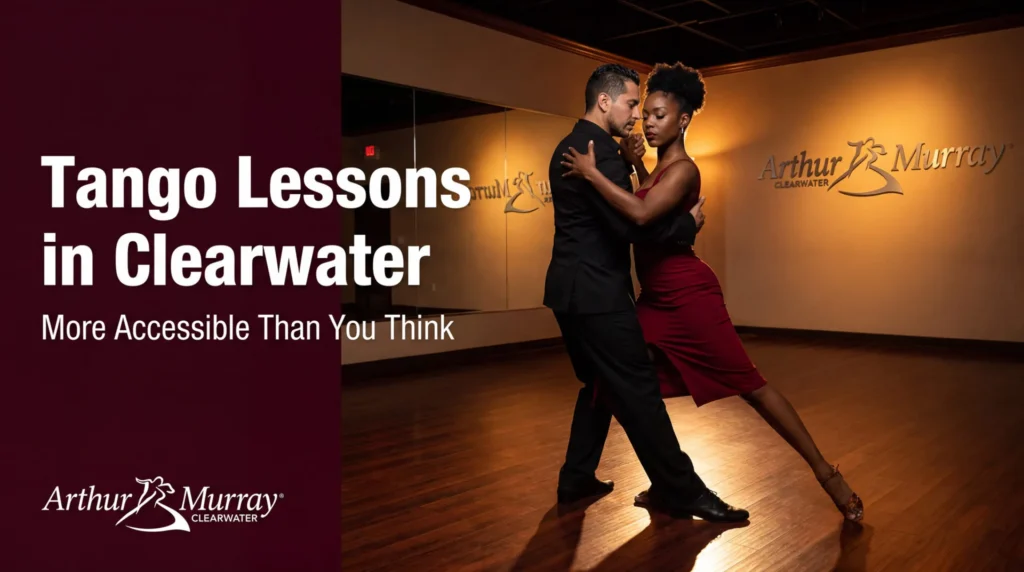
The tango has a reputation that precedes it into every room. Dramatic. Intense. The kind of dance that requires smoldering confidence and a decade of training before you’re allowed anywhere near a dance floor. Watch a professional tango performance and it’s easy to understand where that impression comes from — the sharp head snaps, the precision footwork, the electric tension between partners. It looks like something you’d need to earn.
Here’s what that reputation gets wrong: the tango, taught correctly and progressively, is one of the most rewarding dances a beginner can pursue. The drama you see at the competition level is the product of years of refinement — but the foundation underneath it, the basic connection and intention that make tango tango, is accessible from nearly the first lesson. And once you feel it, even in its simplest form, you understand immediately why this dance has captivated people for over a century.
What Makes Tango Different from Every Other Ballroom Dance
Every ballroom style has a personality.
- The waltz is graceful and flowing.
- The foxtrot is smooth and versatile.
- Salsa is energetic and celebratory.
The tango is something else entirely — it’s the dance that’s built on drama, on contrast, on the push and pull between two people moving in complete synchrony.
Technically, the tango is a ballroom dance danced in a closed hold, but the hold itself is different from what you’d find in a waltz or foxtrot. Partners are closer together, the connection is more direct, and the communication between lead and follow happens with a precision and immediacy that gives the dance its characteristic intensity. The footwork is sharp and deliberate — walks, lunges, and pivots that accent the staccato character of traditional tango music. The posture is upright and proud, with a quality that students often describe as the most physically confident they’ve ever felt on a dance floor.
What’s striking about learning the tango at Arthur Murray Clearwater is how quickly that feeling of confidence arrives. The basic tango walk — forward steps taken with a deliberate, grounded quality — is something most students develop a genuine feel for within a lesson or two. It doesn’t look like a beginner step. It looks like dancing. That early payoff is part of what makes the tango so compelling for students who came in expecting a long runway before anything resembling the real thing.
The Two Tangos: What You Need to Know
The tango world splits into two distinct styles, and the distinction matters enough to address directly. Arthur Murray Clearwater teaches both, and they are genuinely different dances despite sharing a name and a country of origin.
The American tango — sometimes called the ballroom tango — is the style that lives within the broader ballroom dance tradition. It’s danced in the closed hold described above, travels across the floor in a line of dance, and uses the sharp, staccato quality that most people picture when they think of tango. It’s the style that beginners at Arthur Murray typically start with, because it fits within a structured curriculum and builds naturally on foundational partner dancing skills.
The Argentine tango is a different animal entirely. It’s danced in a more intimate embrace, with a deeply improvisational character that makes it one of the most nuanced social dances in the world. Where the ballroom tango uses choreographed figures, the Argentine tango is a conversation — a moment-to-moment exchange between partners that changes with every measure of music. It’s less about memorizing patterns and more about developing a sensitivity to your partner that allows genuine spontaneity. Many dancers who encounter Argentine tango describe it as the deepest and most personal dance they’ve ever experienced.
Both styles are available at Arthur Murray Clearwater. Most beginners find the ballroom tango to be the natural entry point, often exploring Argentine tango later once they have the partner connection and body awareness that makes its improvisational nature fully enjoyable.
Tango in Clearwater: Why the Setting Matters
Learning tango isn’t just about footwork and timing — it’s about atmosphere, and Arthur Murray Clearwater provides exactly the kind of environment where the dance makes sense. The studio’s practice parties and social events create opportunities to experience tango in the context it was built for: with other people, live music, and the energy of a room where dancing is taken seriously and enjoyed completely.
The Tampa Bay area’s active social dance scene means that students who develop tango skills at Arthur Murray Clearwater have genuine places to use them. Regional dance events, ballroom showcases, and studio competitions give students who want to go beyond the social level a structured path to do so. But even for students whose goals are entirely social — wanting to dance at a wedding, impress a partner, or simply feel like someone who knows what they’re doing when a tango comes on — Clearwater’s calendar offers more than enough opportunity to put the skill to use.
What Tango Lessons Look Like at Arthur Murray
Your first tango lesson at Arthur Murray Clearwater begins with posture and hold — because the tango’s entire personality flows from the quality of the physical connection between partners. Your instructor will establish the dance frame, help you understand the directional communication that makes partner dancing work, and introduce the grounded, deliberate quality of the tango walk before any footwork patterns are introduced.
From there, lessons build progressively. The basic tango step, the promenade, the corté, directional changes and weight transfers — each element introduced in context, connected to what came before it, building toward the full vocabulary of the dance without ever handing a student more than they’re ready to work with. Arthur Murray’s curriculum is structured precisely to prevent the overwhelm that comes from being shown too much too fast, because overwhelm produces the paralysis that makes beginners feel like they’ll never get it.
They always get it. The timeline just varies, and that’s entirely normal.
Private tango lessons move at your pace. There’s no fixed schedule that determines when you should advance regardless of whether you’re ready. If a particular concept needs more time, it gets more time. If you move through the foundational material quickly and want to push further, the curriculum has the depth to take you there. Instructors at Arthur Murray Clearwater are trained to work with both kinds of students, and to recognize which kind you are without you having to tell them.
Who the Tango Is For
The honest answer is that the tango is for anyone who is drawn to it. The intimidating reputation is a significant filter — many people who would love the tango never try it because they assume it requires something they don’t have. What it actually requires is a willingness to engage with a dance that rewards presence, precision, and connection with your partner. Those things are learnable. They don’t require natural talent, a particular body type, or prior dance experience.
The tango tends to appeal most strongly to people who want a dance with genuine emotional weight — something that feels like more than steps. Students who come in looking for a challenge, for a dance that keeps giving them something to refine as they advance, almost universally find what they’re looking for in the tango. It also works beautifully for couples, because the intensity of the connection the dance requires tends to produce a quality of attention to each other that students describe as one of the more unexpectedly valuable parts of the experience.
If you’ve been curious about tango lessons in Clearwater and the reputation has been the thing holding you back, let this be the reframe: the drama you see at the competition level is real. So is the accessibility of the dance that underlies it. The gap between where you are and where you want to be is considerably smaller than it looks from the outside.
People Also Ask: Tango Lessons in Clearwater
Is tango hard to learn for beginners?
The foundational tango — the walk, basic hold, and core footwork patterns — is learnable for most beginners within the first few lessons. The dance has significant depth and can take years to master at an advanced level, but social-level tango is genuinely accessible with consistent instruction.
What is the difference between tango and Argentine tango?
The ballroom tango is a structured dance with choreographed figures, danced in a closed hold that travels across the floor. Argentine tango is a deeply improvisational social dance danced in a closer embrace, focused on real-time communication between partners rather than memorized patterns. Both are taught at Arthur Murray Clearwater.
Do I need a partner to take tango lessons?
No. Arthur Murray instructors partner with you in private lessons, teaching you both the lead and follow aspects of the dance. Many students begin tango completely solo and bring a partner in later once they have solid foundational technique.
Is the tango a romantic dance?
The tango is widely considered one of the most emotionally intense partner dances in the world. Its close hold, deliberate movement, and emphasis on partner connection give it a dramatic, romantic quality that distinguishes it from most other ballroom styles. Both the ballroom tango and Argentine tango share this character, though in different ways.
How long does it take to learn the tango?
Most students develop confident basic tango within a few months of consistent private lessons. Social-level comfort — where you can dance at an event or practice party without feeling lost — is typically achievable within that timeline. Advanced tango, particularly Argentine tango, is a lifelong pursuit with no ceiling.
Is tango good for couples to learn together?
Absolutely. The tango’s emphasis on partner connection and communication makes it one of the most rewarding dances for couples to learn together. Many couples who start with tango lessons at Arthur Murray Clearwater describe it as one of the better things they’ve done for their relationship, independent of the dancing itself.
Ready to Try Tango Lessons in Clearwater?
Arthur Murray Clearwater offers a free introductory lesson for new students — a straightforward way to experience the tango firsthand, without the pressure of a long-term commitment, and find out whether the dance lives up to everything its reputation promises.
It will.
Reach out to Arthur Murray Clearwater to ask about the current intro offer and take the first step onto the floor.
“`